
Social Media Marketing Types: 12 Key Methods, Strategies & Examples
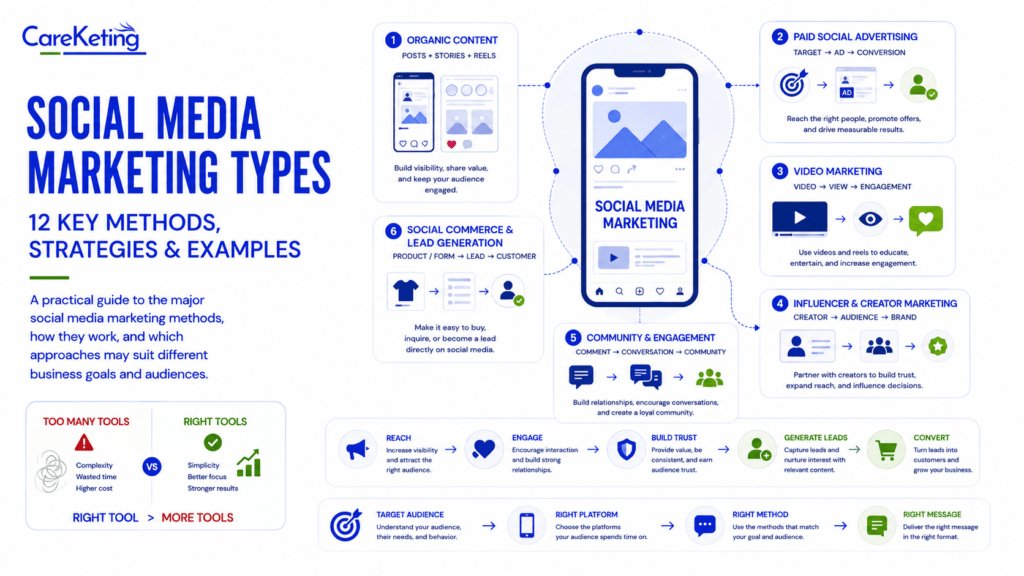
A practical guide to the major social media marketing types, how each method works, and which approach may suit different business goals and audiences.
Introduction
Understanding the different social media marketing types becomes much easier when you stop thinking of social media as simply a place to post pictures.
Businesses use social platforms for very different reasons. A local restaurant may want more customers, a manufacturer may want distributor enquiries, and a service company may want to build trust before someone contacts its sales team.
The right social media marketing types depend on the audience, business objective, available resources, and customer journey. Some methods focus on visibility, while others are designed for engagement, lead generation, or direct sales.
This guide explains 12 practical methods with examples so you can identify which approaches make sense for your business.
Table of Contents
What Are Social Media Marketing Types?
Social media marketing types are different approaches businesses use to communicate with audiences, promote products and services, build communities, generate leads, and achieve marketing objectives through social platforms.
These methods can be grouped into organic activity, paid advertising, content based marketing, community interaction, influencer activity, and performance focused campaigns.
There is no requirement to use every method. In practice, businesses usually get better results when they select a few approaches that match their customers.
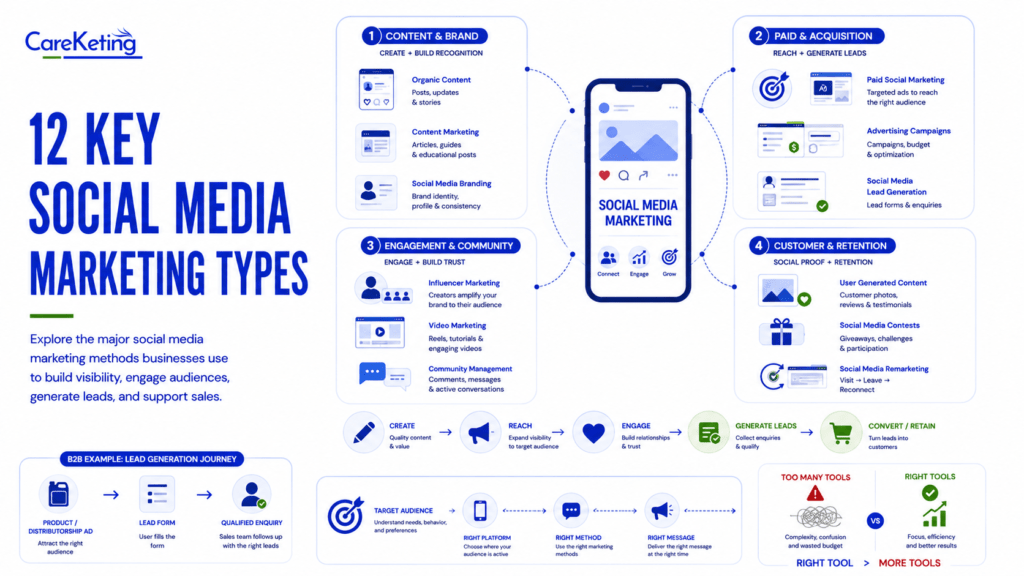
12 Key Social Media Marketing Types
1. Organic Social Media Marketing
Organic social media marketing involves publishing content without directly paying for distribution.
Businesses can share educational posts, product information, company updates, customer stories, and useful industry content.
For example, a manufacturer could regularly explain product applications and answer common buyer questions through social media content.
2. Paid Social Media Marketing
Paid social media marketing uses advertising budgets to reach selected audiences.
Platforms can provide targeting options based on available audience signals. Businesses can promote products, services, offers, lead forms, or website pages.
This is one of the more measurable social media marketing types because businesses can compare spending with results such as leads or conversions.
3. Social Media Content Marketing
This approach focuses on creating useful content rather than making every post promotional.
Content can include educational articles, tips, guides, product explanations, case studies, and industry insights.
A B2B company, for example, could explain how buyers should evaluate a particular product before making a purchase.
4. Social Media Advertising Campaigns
A structured advertising campaign usually has a defined objective, audience, creative, budget, and measurement system.
A local business might run a campaign for enquiries, while an ecommerce brand could promote specific products.
The important point is to connect the campaign objective with the desired customer action.
5. Social Media Lead Generation
Social media lead generation focuses on turning audience attention into enquiries.
Businesses can use lead forms, landing pages, direct messages, calls, or WhatsApp conversations depending on their setup.
For example, a lubricant manufacturer looking for distributors could run advertisements specifically asking interested distributors to submit their business details.
6. Influencer Marketing
Influencer marketing involves working with creators who have an audience relevant to the business.
Follower count should not be the only selection criterion. Audience relevance, trust, content quality, and engagement can be more important.
For niche products, a smaller creator with a highly relevant audience may produce better commercial value than a large general creator.
7. Video Marketing on Social Media
Video is useful when a product, service, process, or idea is easier to understand visually.
Businesses can create demonstrations, tutorials, interviews, customer stories, factory videos, short educational clips, and product comparisons.
For manufacturers, showing how a product is made or used can provide information that a static post cannot communicate as clearly.
8. Community Management
Community management focuses on conversations rather than simply publishing content.
It includes responding to comments, answering questions, managing messages, addressing concerns, and encouraging useful discussions.
This approach can help businesses strengthen customer relationships and identify recurring questions.
9. Social Media Branding
Social media branding focuses on creating a recognizable identity across social platforms.
Visual style, tone of voice, photography, messaging, and content themes should feel consistent.
However, good branding is not only about attractive graphics. The business also needs to communicate what it stands for and why customers should remember it.
10. User Generated Content
User generated content is created by customers rather than the business itself.
Examples include customer photographs, product experiences, testimonials, reviews, or videos.
Genuine customer content can provide useful social proof because potential buyers can see how other people experience the product or service.
11. Social Media Contests
Contests can be used to encourage participation and increase interaction.
For example, a food brand could invite customers to share their favourite product combination. However, contests should have a clear purpose and comply with the relevant platform rules.
A contest that attracts thousands of irrelevant participants may create activity without creating meaningful business value.
12. Social Media Remarketing
Remarketing allows businesses to communicate again with people who have previously interacted with their digital presence, where platform capabilities and applicable privacy requirements allow it.
For example, an ecommerce business may show relevant product advertising to people who previously visited a product page.
This can be useful because these users have already demonstrated some level of interest.
How to Choose the Right Social Media Marketing Type
The right social media marketing types should be selected according to the customer journey.
Start by answering four questions:
Who is the customer?
What does the business want to achieve?
Which platform does the audience actually use?
What action should the customer take?
For example, a local service business may combine organic content, community management, and local advertising.
A B2B manufacturer may focus on educational content, video marketing, lead generation, and targeted advertising.
A consumer brand may rely more heavily on influencer campaigns, user generated content, video, and paid promotion.
Common Mistakes
A frequent mistake is trying to use every available social media channel at once.
Another is creating content without a clear audience or objective. Posting consistently is useful only when the content has a reason to exist.
Businesses also sometimes judge social media marketing types only by likes and followers. Those metrics can be useful, but they do not necessarily indicate revenue or lead quality.
Social media analytics should therefore connect activity with meaningful outcomes.
Frequently Asked Questions
What are the main social media marketing types?
The major social media marketing types include organic marketing, paid advertising, content marketing, lead generation, influencer marketing, video marketing, community management, branding, user generated content, contests, and remarketing.
Which social media marketing type is best for small businesses?
There is no universal answer. Organic content, local advertising, community management, and lead generation can be useful depending on the business and target audience.
What is the difference between organic and paid social media marketing?
Organic marketing relies on unpaid content and audience interaction, while paid social media marketing uses advertising budgets to distribute content or offers to selected audiences.
Is influencer marketing suitable for B2B businesses?
It can be, although the approach is different. B2B companies may work with industry experts, professionals, educators, or niche creators whose audiences include relevant decision makers.
Which social media marketing type is best for lead generation?
Paid social advertising and dedicated lead generation campaigns can be effective, especially when the audience, offer, creative, and qualification process are well defined.
How do I measure social media marketing performance?
Useful metrics depend on the objective. Businesses may track reach, engagement, website visits, leads, qualified enquiries, cost per lead, conversions, sales, and revenue.
Conclusion
The different social media marketing types give businesses several ways to attract attention, communicate with customers, build credibility, and generate commercial opportunities.
But using more methods does not automatically create better marketing. A small business may need only two or three carefully selected approaches. A larger B2B company may require a combination of content, video, paid campaigns, lead generation, and community management.
The best approach is to begin with the customer and business objective. Then select the social media marketing method that gives you the strongest opportunity to achieve that objective.
Before choosing your next social media approach, define your target audience, business goal, preferred platform, content format, budget, and success metric. This will help you choose the social media marketing types that actually fit your business rather than simply following trends.