
Digital Marketing Tools: 25 Best Tools for SEO, Social Media, Analytics & More
A practical guide to digital marketing tools for SEO, content creation, social media, advertising, analytics, email marketing, lead generation, and campaign management.
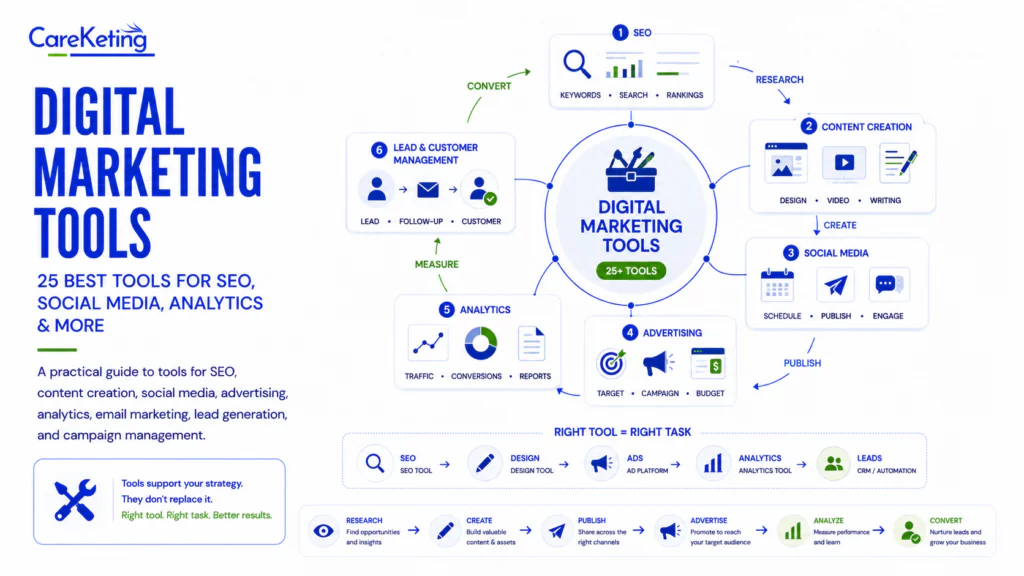
Introduction
The right digital marketing tools can save hours of manual work, improve campaign tracking, and help businesses make better marketing decisions. But having more software does not automatically mean having better marketing.
A small business may need only a few reliable tools, while a growing company may require a wider technology stack covering SEO, advertising, customer relationship management, content, and analytics.
The important question is not, “Which tools are popular?” It is, “Which tools solve the problems my business actually has?”
This guide covers 25 useful digital marketing tools and explains where each category fits into a practical marketing workflow.
Table of Contents
What Are Digital Marketing Tools?
Digital marketing tools are software applications and platforms that help businesses plan, execute, manage, measure, and improve online marketing activities.
They can support tasks such as keyword research, website analytics, social media management, email automation, graphic design, advertising, lead generation, customer management, and conversion tracking.
The goal is not to collect software. The goal is to create a marketing system where each tool has a clear purpose.
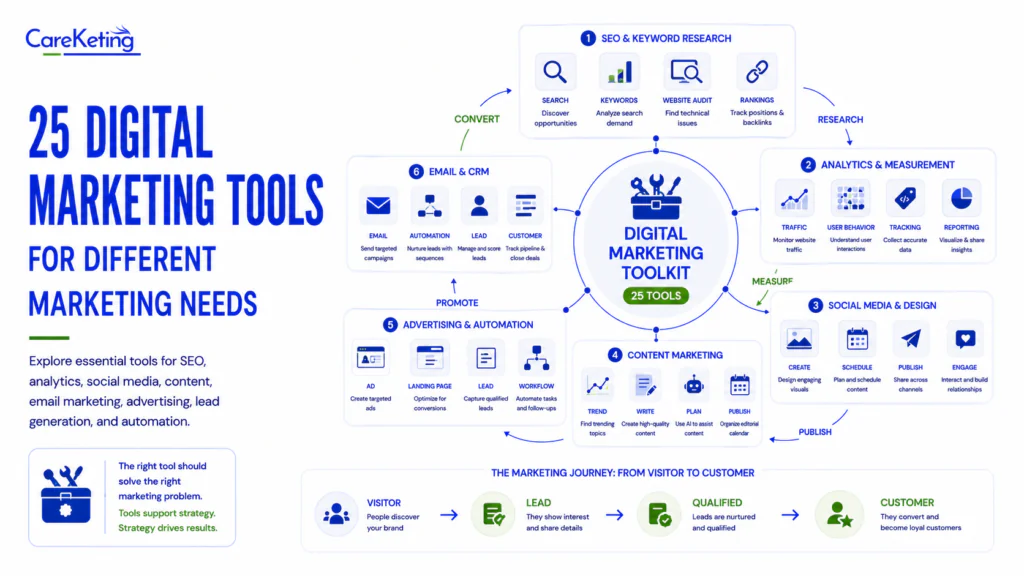
25 Digital Marketing Tools for Different Marketing Needs
SEO and Keyword Research Tools
1. Google Search Console
Useful for monitoring how a website appears in Google Search, including search queries, clicks, impressions, and indexing information.
2. Google Keyword Planner
Useful for researching search terms and understanding potential keyword demand, particularly when planning search advertising campaigns.
3. Ahrefs
Ahrefs provides features for keyword research, backlink analysis, competitor research, and SEO monitoring.
4. Semrush
Semrush combines SEO, keyword research, competitor analysis, content research, and advertising related features.
5. Screaming Frog SEO Spider
This tool can crawl websites and identify technical SEO issues such as broken links, duplicate information, missing metadata, and other structural problems.
Analytics and Measurement Tools
6. Google Analytics
Google Analytics helps businesses understand website traffic, user behaviour, acquisition sources, and conversions.
7. Looker Studio
Useful for turning marketing data into visual reports and dashboards.
For an agency managing several clients, reporting tools can reduce repetitive manual work.
8. Google Tag Manager
Google Tag Manager helps marketers manage website tracking tags without repeatedly editing website code for every tracking requirement.
9. Microsoft Clarity
Clarity provides session recordings and heatmaps that can help identify how visitors interact with web pages.
Social Media Marketing Tools
10. Meta Business Suite
Useful for managing Facebook and Instagram content, messages, basic insights, and other business activities.
11. Buffer
Buffer helps businesses plan and schedule social media content across supported platforms.
12. Hootsuite
Hootsuite provides social media management features for publishing, monitoring, and reporting.
13. Canva
Canva is a widely used graphic design platform for creating social media posts, presentations, advertisements, and other marketing materials.
For small businesses without an in house designer, a simple content creation tool can make regular publishing easier.
Content Marketing Tools
14. Google Trends
Google Trends helps marketers understand how interest in search topics changes over time.
15. Grammarly
Useful for checking grammar, spelling, clarity, and writing style before publishing marketing content.
16. ChatGPT
AI tools can assist with brainstorming, outlining, research organization, content variations, and repetitive marketing tasks. Human review remains important, particularly for claims, brand voice, and original insights.
17. Notion
Notion can be used to organize content ideas, marketing plans, briefs, research, and editorial calendars.
Email Marketing Tools
18. Mailchimp
Mailchimp provides tools for email campaigns, audience management, automation, and reporting.
19. Brevo
Brevo offers email marketing, automation, contact management, and related communication features.
20. HubSpot
HubSpot combines CRM functionality with marketing, sales, customer service, and automation features.
For businesses with longer sales cycles, connecting marketing activity with CRM data can provide a clearer view of lead quality.
Advertising and Lead Generation Tools
21. Meta Ads Manager
Meta Ads Manager is used to create and manage advertising campaigns across supported Meta platforms.
Businesses can use it for objectives such as lead generation, website traffic, sales, and awareness.
22. Google Ads
Google Ads allows businesses to advertise across Google’s advertising ecosystem, including search campaigns.
A local service business, for example, can target people actively searching for relevant services.
23. Unbounce
Unbounce provides tools for creating and testing landing pages designed for marketing campaigns.
24. Zoho CRM
Zoho CRM helps businesses organize leads, customer information, sales activities, and follow up.
25. Zapier
Zapier connects different applications and can automate repetitive workflows.
For example, a lead generated through an advertising campaign could potentially trigger actions in a CRM or spreadsheet through an appropriate integration.
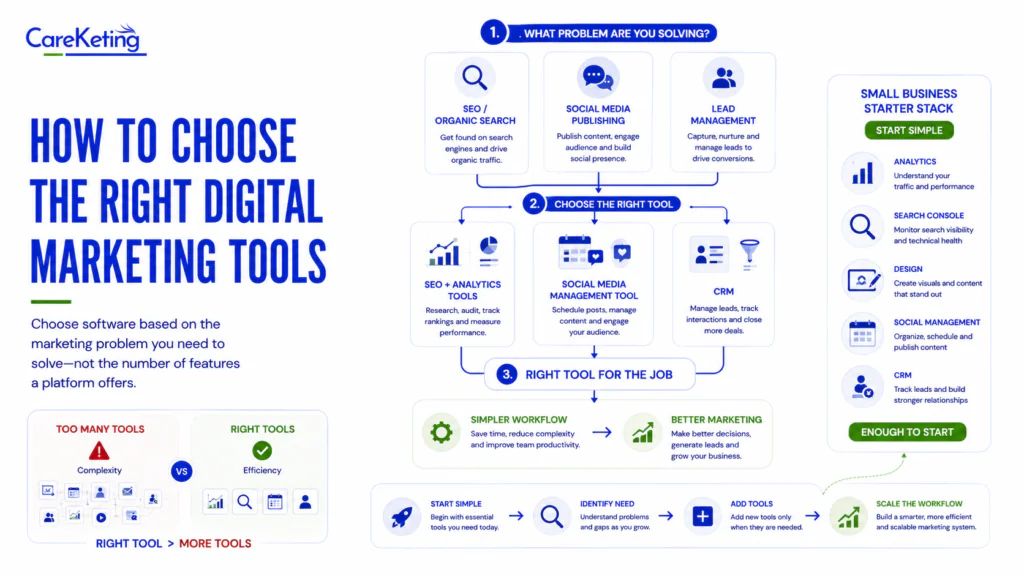
How to Choose the Right Digital Marketing Tools
Do not start by asking which software you should buy.
Start by identifying the marketing problem.
If organic search is the priority, SEO and analytics tools may be more useful. If the main problem is inconsistent social media publishing, a social media management platform may be enough.
A small business could begin with Google Analytics, Google Search Console, Canva, Meta Business Suite, and a CRM before considering more advanced software.
As marketing activity grows, additional digital marketing software can be introduced when there is a genuine need.
Common Mistakes When Choosing Marketing Tools
The biggest mistake is paying for features nobody uses.
Another is using several tools that perform almost the same function. This can create duplicated data and unnecessary costs.
Businesses also sometimes invest heavily in marketing automation tools before they have a reliable marketing process. Automation works best when the underlying process is already clear.
Most importantly, tools do not replace strategy. A poor campaign cannot be fixed simply by adding more software.
Frequently Asked Questions
What are digital marketing tools?
Digital marketing tools are software platforms used to plan, create, manage, measure, and improve online marketing activities.
Which digital marketing tools are best for beginners?
Beginners can start with Google Search Console, Google Analytics, Canva, Meta Business Suite, Google Keyword Planner, and a simple CRM.
Are digital marketing tools free?
Some tools offer free versions, while others require paid subscriptions. The available features and limits vary between platforms.
Which tools are useful for SEO?
Google Search Console, Google Keyword Planner, Ahrefs, Semrush, and Screaming Frog are commonly used for different SEO tasks.
Which tools help with social media marketing?
Meta Business Suite, Buffer, Hootsuite, Canva, and platform specific analytics tools can support different social media activities.
Do small businesses need 25 marketing tools?
No. Most small businesses do not need 25 tools. A smaller collection that solves the most important marketing problems is usually more practical.
Conclusion
The best digital marketing tools are not necessarily the ones with the longest feature lists. They are the tools that help your team solve real problems and make better decisions.
SEO, social media, advertising, content, email, analytics, and CRM systems each have different roles. The right combination depends on your business model, budget, team, customers, and marketing objectives.
A sensible approach is to start small, measure what you are doing, and add new digital marketing tools only when they provide a clear benefit.
Before subscribing to another marketing platform, list the three biggest problems slowing down your marketing work. Choose tools that directly solve those problems, then review their value regularly.