
Digital Marketing Platforms: 15 Best Platforms & Channels Explained
A practical guide to digital marketing platforms, their different types, major channels, and how businesses can choose the right platforms for their marketing goals.
Introduction
Choosing between different digital marketing platforms can be confusing, especially when every platform appears to offer a different way to reach customers.
A small local business may need Google Search and Instagram, while a B2B manufacturer may get better results from LinkedIn, Google Ads, and email marketing. An ecommerce company may need several platforms working together across advertising, content, analytics, and customer communication.
The important point is that there is no universal list of platforms that works equally well for every business. The right choice depends on your audience, marketing objective, budget, sales process, and type of product or service.
This guide explains 15 important digital marketing platforms and where each one fits into a practical marketing strategy.
Table of Contents
What Are Digital Marketing Platforms?
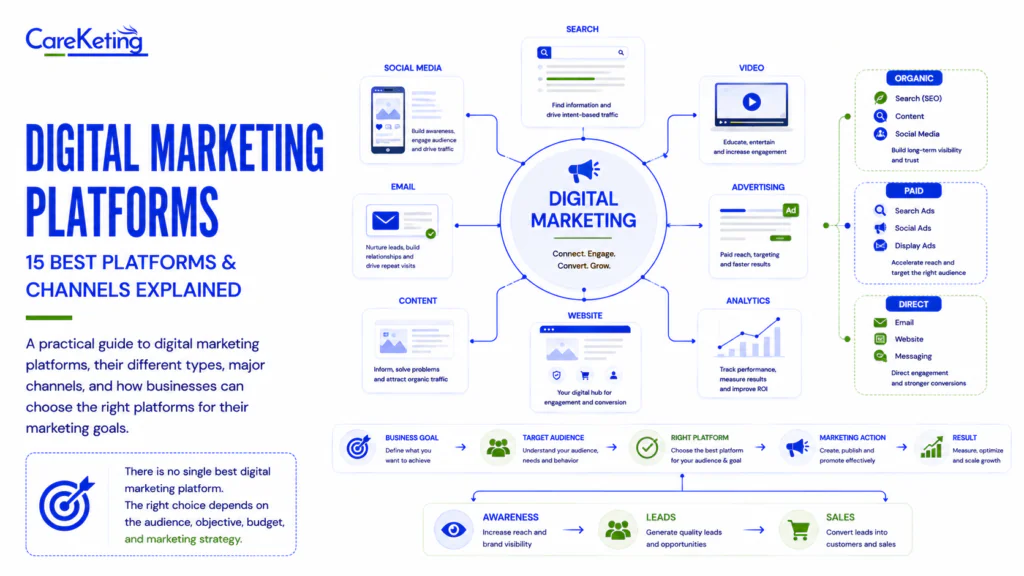
Digital marketing platforms are websites, software systems, networks, or online environments that businesses use to promote products and services, communicate with customers, distribute content, generate leads, advertise, and measure marketing performance.
They can be divided into several groups, including search engines, social media, advertising networks, content platforms, email systems, ecommerce platforms, and analytics systems.
Understanding these categories makes it easier to build a sensible marketing plan instead of trying to be active everywhere.
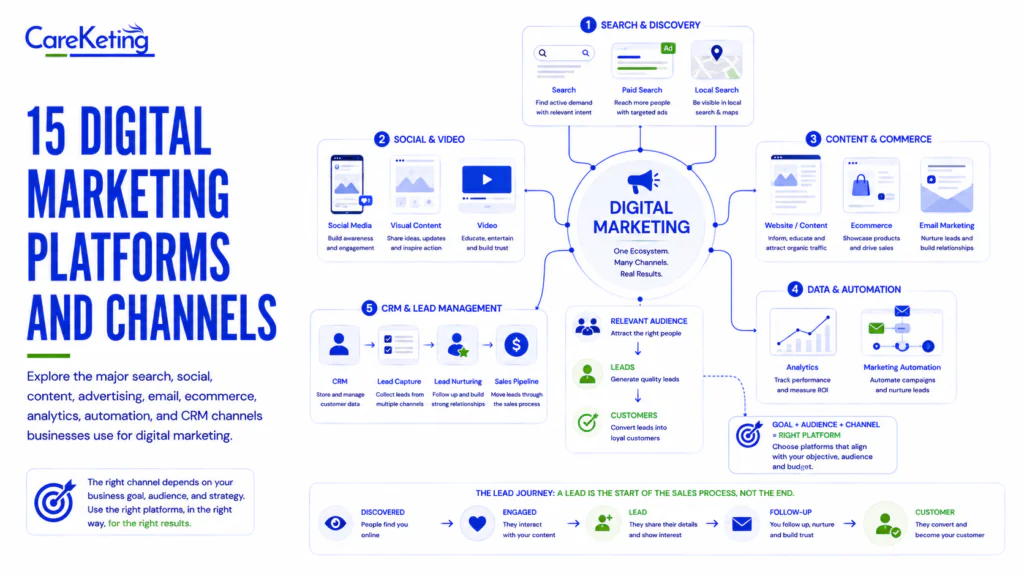
15 Digital Marketing Platforms and Channels
1. Google Search
Google Search is one of the most important search engine platforms for businesses.
Companies can appear through organic SEO results or paid search advertising. A local plumber, for example, can target people actively searching for plumbing services in their city.
2. YouTube
YouTube is useful for video marketing, education, product demonstrations, tutorials, reviews, and longer explanations.
Manufacturers can use it to demonstrate products or explain technical applications that may be difficult to communicate through a static advertisement.
3. Facebook
Facebook can support organic content, communities, customer communication, and paid advertising.
It can be particularly useful for local businesses and companies targeting specific consumer or business audiences through advertising.
4. Instagram
Instagram is strongly focused on visual communication.
Businesses can use posts, Stories, Reels, and advertising to showcase products, explain services, build brand recognition, and engage audiences.
5. LinkedIn
LinkedIn is especially relevant to B2B marketing and professional audiences.
A manufacturer, software company, consultant, or business service provider can use LinkedIn for thought leadership, company communication, networking, and lead generation.
6. Google Ads
Google Ads is a major digital advertising platform.
It allows businesses to advertise across Google’s advertising ecosystem. Search campaigns are particularly useful when customers already have a clear intent to find a product or service.
7. Meta Ads
Meta’s advertising system allows businesses to create campaigns across supported Meta properties.
It can be used for awareness, website traffic, lead generation, engagement, sales, and other objectives.
For example, a financial service provider could create a campaign targeting people who may be interested in a specific type of financing.
8. Pinterest
Pinterest can be useful for businesses where visual discovery influences purchasing decisions.
Home decor, fashion, food, travel, crafts, and lifestyle businesses may find it useful as a content discovery and traffic channel.
9. Email Marketing Platforms
Email marketing platforms allow businesses to communicate directly with subscribers and customers.
They can support newsletters, promotional messages, customer education, onboarding, and automated communication.
Email remains useful because businesses can build an audience they can communicate with directly rather than depending entirely on social platform reach.
10. Content Marketing Platforms
Platforms such as WordPress allow businesses to publish articles, guides, case studies, landing pages, and other website content.
For SEO focused businesses, a website can become a long term content distribution platform that attracts visitors through search.
11. Ecommerce Marketing Platforms
Platforms such as Shopify can provide businesses with infrastructure for selling products online.
Ecommerce marketing can then connect product pages with search, social media, email, paid advertising, and analytics.
12. Google Business Profile
For local businesses, Google Business Profile is an important part of local digital marketing.
It can help customers discover business information through Google Search and Maps, including location, contact information, reviews, and operating details.
13. Analytics Platforms
Analytics platforms help businesses understand what happens after people interact with their marketing.
Google Analytics is one example. Businesses can use analytics to study traffic sources, user behaviour, conversions, and other relevant performance information.
14. Marketing Automation Platforms
Marketing automation platforms help businesses automate repetitive marketing tasks.
Depending on the platform, this can include email sequences, customer segmentation, lead management, notifications, and campaign workflows.
Automation is most useful when the underlying marketing process is already clearly defined.
15. CRM and Lead Generation Platforms
CRM platforms help businesses organize leads and customer relationships.
For a B2B company with a longer sales cycle, a CRM can track enquiries, follow ups, sales stages, and customer information.
This is particularly important because generating a lead is only the beginning. The business must also respond, qualify, follow up, and convert that opportunity.
How to Choose the Right Digital Marketing Platforms
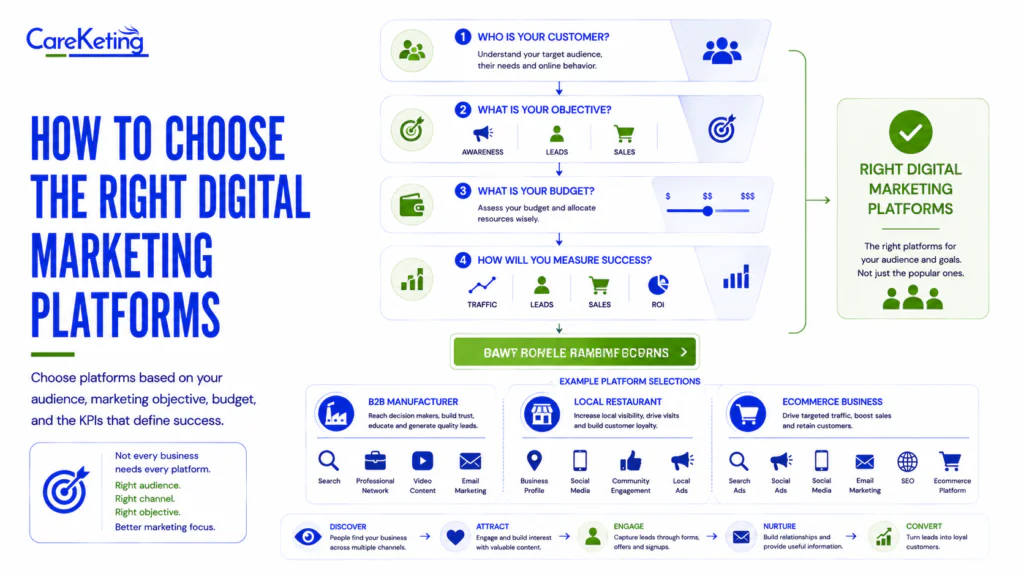
The best digital marketing platforms should be selected according to four basic questions:
Who is your customer?
Understand where your target audience spends time and how they research products.
What is your objective?
Brand awareness, website traffic, lead generation, sales, and customer retention require different approaches.
What is your budget?
Paid advertising can accelerate reach, while organic channels may require more time and consistent content.
How will you measure success?
Define relevant KPIs before launching campaigns. A lead generation campaign should not be judged only by impressions, for example.
A B2B manufacturer might choose Google Search, LinkedIn, YouTube, and email.
A local restaurant might focus on Google Business Profile, Instagram, Facebook, and local advertising.
An ecommerce business may combine Google Ads, Meta Ads, Instagram, email, SEO, and its ecommerce platform.
Common Mistakes
One common mistake is trying to maintain every available channel.
Another is choosing a platform because competitors use it without checking whether the audience is relevant.
Businesses also sometimes measure activity rather than outcomes. High reach does not necessarily mean high sales, and many followers do not necessarily mean many customers.
A smaller number of well managed digital marketing platforms can be more useful than a large collection of poorly managed channels.
Frequently Asked Questions
What are digital marketing platforms?
Digital marketing platforms are online systems and channels businesses use for advertising, content distribution, customer communication, lead generation, sales, and marketing measurement.
Which digital marketing platform is best?
There is no single best platform. The right choice depends on the target audience, business model, marketing objective, budget, and customer journey.
What are the major types of digital marketing platforms?
Major categories include search engines, social media platforms, advertising networks, content platforms, email marketing platforms, ecommerce platforms, analytics systems, CRM platforms, and marketing automation platforms.
Which platforms are best for B2B marketing?
LinkedIn, Google Search, Google Ads, YouTube, email marketing, company websites, and CRM systems can be useful for B2B businesses, depending on the industry and sales process.
Which digital marketing platforms are useful for local businesses?
Google Business Profile, Google Search, Instagram, Facebook, local advertising, and a well optimized website can form a strong foundation for many local businesses.
How many digital marketing platforms should a business use?
There is no fixed number. Start with the platforms most relevant to your customers and objectives. Add additional channels when there is a clear reason to do so.
Conclusion
The right digital marketing platforms can help a business reach potential customers, communicate its value, generate enquiries, build relationships, and measure marketing performance.
However, choosing platforms should never become the strategy itself.
Start with the customer and the business objective. Then select the channels that give you a realistic opportunity to reach that customer and achieve that objective.
For most businesses, depth is more useful than simply being present everywhere. A few well managed digital marketing platforms with clear measurement can produce more meaningful results than a large collection of neglected channels.
Before choosing another marketing channel, identify where your customers actually search, compare, and make decisions. Then build your marketing around those platforms rather than trying to maintain every available channel.