
SEM in Digital Marketing: Meaning, Benefits, Strategy & Examples
A practical guide to understanding SEM in digital marketing, how paid search works, how businesses use search advertising, and how to measure campaign performance.
Introduction
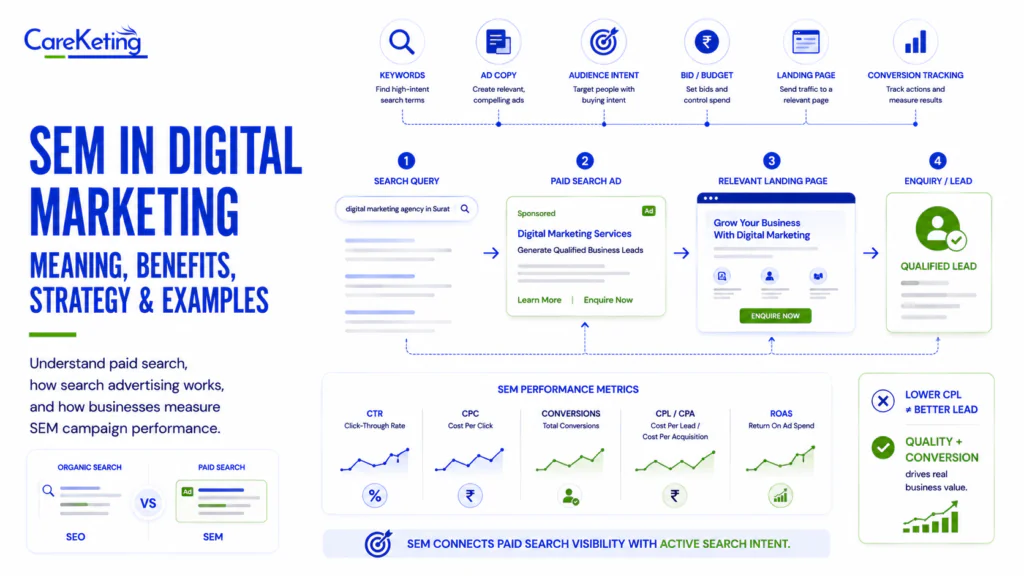
If you have searched for a product or service on Google and noticed sponsored results above the regular listings, you have already seen SEM in digital marketing.
SEM stands for Search Engine Marketing. In practical terms, it refers to using paid search advertising to place business offers in front of people searching for relevant products, services, or information.
For example, a local business selling air conditioners can advertise when someone searches for “AC repair near me.” A B2B manufacturer might advertise for a specific industrial product that potential buyers are actively researching.
The value of SEM in digital marketing comes from connecting advertising with existing search intent. Instead of waiting for someone to discover a brand, businesses can compete for attention when relevant searches happen.
Table of Contents
What Is SEM in Digital Marketing?
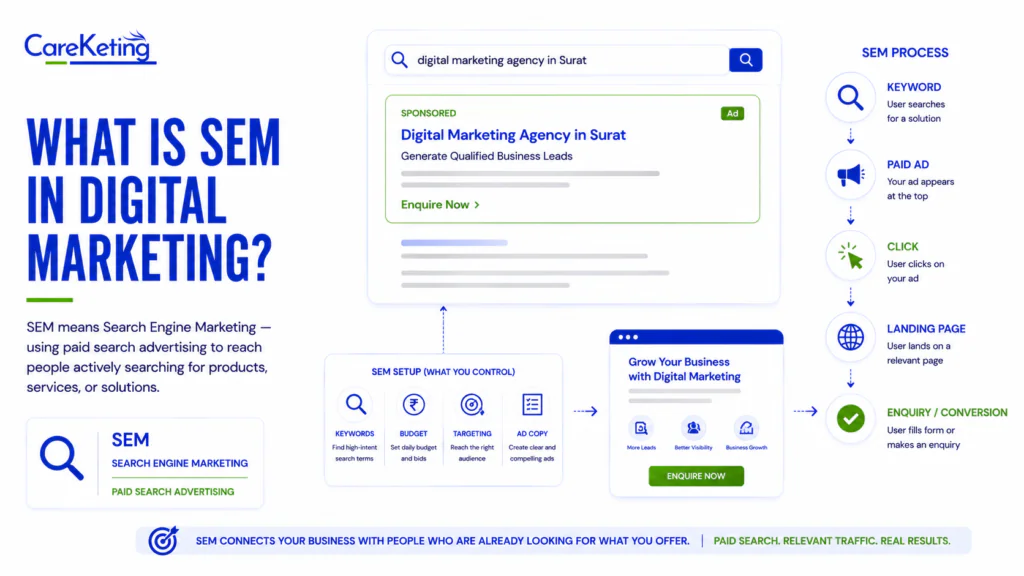
SEM in digital marketing is the use of paid search advertising to promote websites, products, services, or offers on search engine results pages.
The SEM full form is Search Engine Marketing.
A simple search engine marketing definition is:
Search Engine Marketing is a paid advertising approach where businesses promote their offerings through search engines and pay according to the advertising model used by the platform.
Google Ads is the most familiar example.
When a business creates a paid search campaign, it selects relevant keywords, prepares advertisements, sets targeting and budget parameters, and competes for available advertising placements.
SEM Meaning in Digital Marketing: How Does It Work?
The SEM meaning in digital marketing becomes clearer when you understand the basic process.
1. Keyword Selection
Advertisers identify searches that potential customers may use.
For example, a dental clinic might target terms related to dental treatment, while an industrial supplier could target specific product names.
2. Keyword Bidding
Businesses establish bids and budgets for selected search terms.
However, simply offering the highest amount does not guarantee the best advertising position. Search advertising platforms consider several factors when determining ad placement and cost.
3. Ad Creation
The advertiser writes a relevant search advertisement that encourages the user to take an appropriate action.
The message should match the keyword and the landing page.
4. Landing Page
After clicking an advertisement, users should reach a page that clearly explains the relevant product or service.
A good advertisement cannot compensate for a confusing landing page.
5. Measurement
Campaign performance can be evaluated using metrics such as impressions, clicks, click through rate, cost per click, conversions, cost per conversion, and return on advertising spend where applicable.
Benefits of SEM in Digital Marketing
There are several SEM benefits, particularly for businesses that want to reach people with existing search intent.
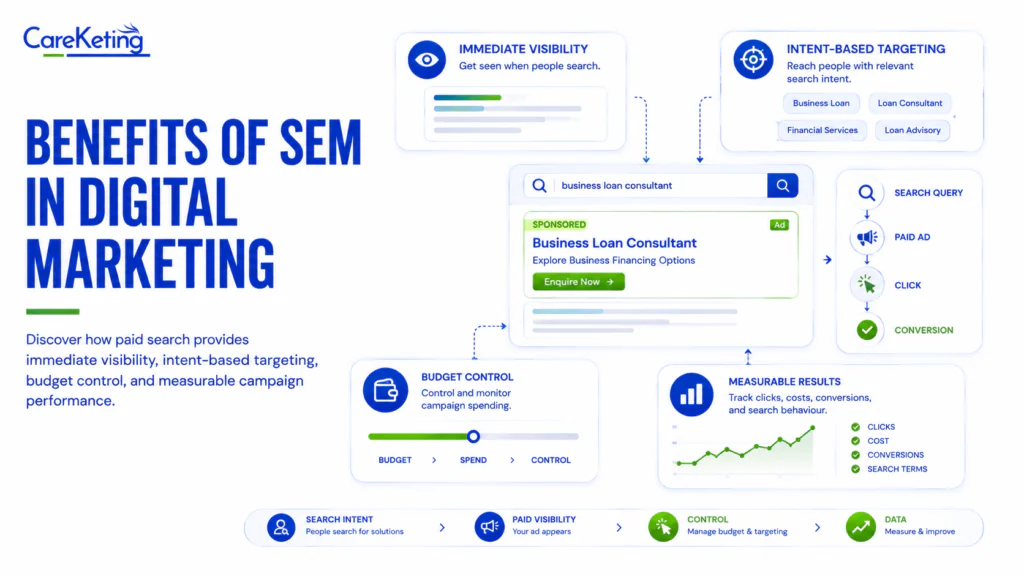
Immediate Visibility
Unlike organic SEO, paid search can provide advertising visibility soon after campaigns are approved and launched.
Intent Based Targeting
Search queries can indicate what someone wants at that moment.
Someone searching for “business loan consultant” may have considerably stronger commercial intent than someone casually reading a general finance article.
Budget Control
Advertisers can establish campaign budgets and monitor spending.
This makes SEM suitable for businesses that want controlled experiments before increasing investment.
Measurable Results
One of the major benefits of SEM in digital marketing is the amount of campaign data available.
Businesses can analyse clicks, costs, conversions, search terms, and other performance indicators to understand whether the campaign is producing useful outcomes.
How to Build an Effective SEM Strategy
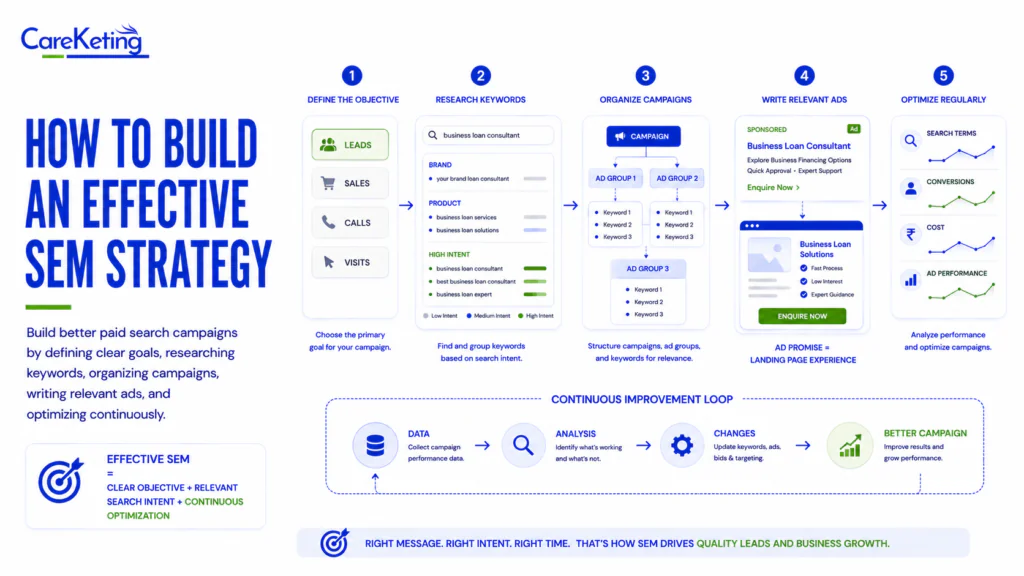
A practical SEM strategy should start with the business objective rather than the advertising platform.
Define the Objective
Decide whether you want leads, sales, calls, website visits, or another measurable outcome.
Research Keywords
Separate keywords according to relevance and commercial intent.
A manufacturer may create different campaigns for product searches, brand searches, and high intent buyer queries.
Organize Campaigns
Group related keywords and advertisements logically.
This makes campaign management and performance analysis easier.
Write Relevant Ads
The advertisement should clearly communicate what the customer is likely to find after clicking.
Avoid making promises that the landing page cannot support.
Optimize Regularly
SEM is not a set and forget activity.
Review search terms, conversion data, costs, advertisements, landing pages, and audience performance. Pause weak areas and test improvements based on evidence.
SEM Example for a Local Business
Imagine a local pest control company wants more service enquiries.
It could create paid search campaigns around relevant service terms and target its operating area.
Someone searching for a pest control service may see the company’s sponsored result and visit the landing page.
If the page clearly explains the service, service area, pricing approach, and enquiry process, the visitor has a straightforward path toward making contact.
The business can then evaluate whether the campaign is generating qualified enquiries at an acceptable cost.
Common SEM Mistakes
One common mistake is targeting too many unrelated keywords.
Another is sending every advertisement to the same generic homepage.
Businesses also sometimes focus heavily on clicks without checking whether those clicks generate useful enquiries or sales.
A high click through rate can look impressive, but if visitors do not take meaningful actions, the campaign may still be commercially weak.
This is why SEM in digital marketing should be evaluated against actual business outcomes.
Frequently Asked Questions
What is SEM full form?
SEM stands for Search Engine Marketing.
What is SEM in digital marketing?
SEM in digital marketing refers to using paid search advertising to promote products, services, or websites through search engines.
Is SEM the same as PPC?
The terms are often used together because paid search commonly uses pay per click advertising. However, SEM can be used as a broader term for search engine marketing.
What is the difference between SEM and SEO?
SEO focuses primarily on improving organic search visibility, while SEM commonly refers to paid search advertising. Both can be part of a wider search marketing strategy.
What are the main SEM benefits?
Key benefits include faster visibility, intent based targeting, budget control, measurable performance, and the ability to reach people actively searching for relevant offerings.
How much does SEM cost?
There is no fixed cost. Advertising expenses depend on factors such as keyword competition, bids, targeting, industry, campaign quality, and conversion performance.
Conclusion
SEM in digital marketing gives businesses a practical way to reach potential customers when they are actively searching for relevant products or services.
The strongest campaigns are not simply the ones that generate the most clicks. They are the campaigns that connect relevant keywords with useful advertisements, strong landing pages, appropriate targeting, and measurable business outcomes.
SEM can be particularly useful for local businesses, service providers, ecommerce companies, manufacturers, and B2B businesses where search intent plays an important role in the buying process.
The best starting point is simple: understand what your customers search for, identify the searches that have genuine business value, and build campaigns around those opportunities.
Before launching a paid search campaign, list the search terms your best customers would use when they are ready to contact or buy from your business. Start with the most relevant opportunities and measure the results carefully.