
SEO and Lead Generation: How to Generate Quality Leads with Organic Search
A practical guide to using SEO, search intent, content, and conversion optimization to attract qualified prospects and generate leads organically.
Introduction
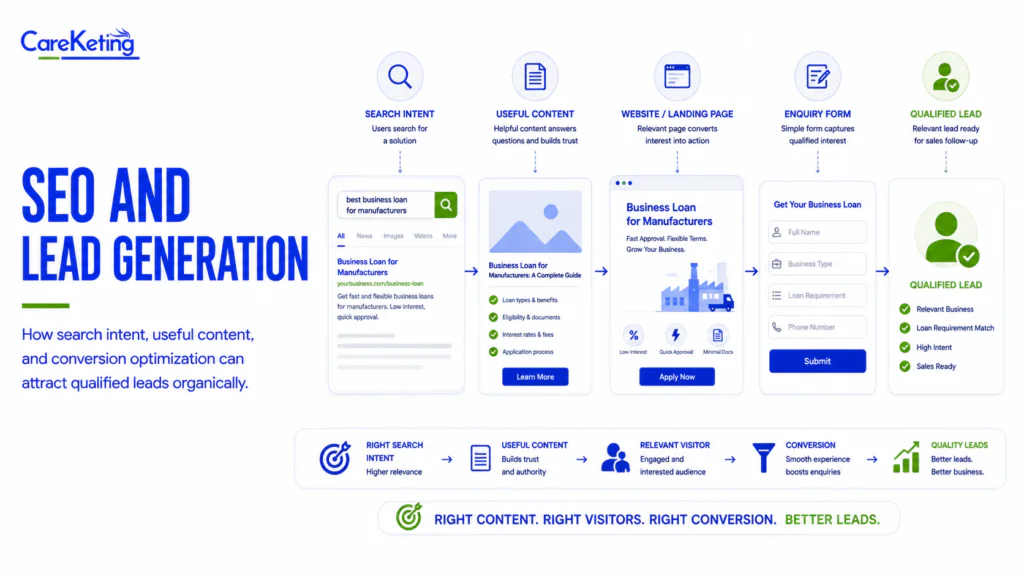
Getting website visitors is useful, but traffic alone does not grow a business. The real value comes when the right visitors become enquiries, calls, consultations, or customers. This is where SEO and lead generation work together.
SEO helps your business appear when people are actively searching for information, products, or services. Lead generation then gives those visitors a clear path to take action.
For example, a manufacturer may rank for a search such as “industrial lubricant supplier in India.” If the visitor finds a useful product page, sees relevant information, and can easily request a quotation, organic search can become a reliable source of business enquiries.
That is the practical connection between SEO and lead generation.
Table of Contents
What Is SEO Lead Generation?
SEO lead generation is the process of using search engine optimization to attract relevant visitors and convert them into potential customers.
Unlike some forms of advertising where you pay for every click, organic search traffic can continue arriving after your content has gained visibility.
However, ranking alone is not enough.
A business needs to target the right searches, create useful content, provide a strong user experience, and make conversion easy.
This makes SEO and lead generation a combination of visibility and conversion.
How SEO and Lead Generation Work Together
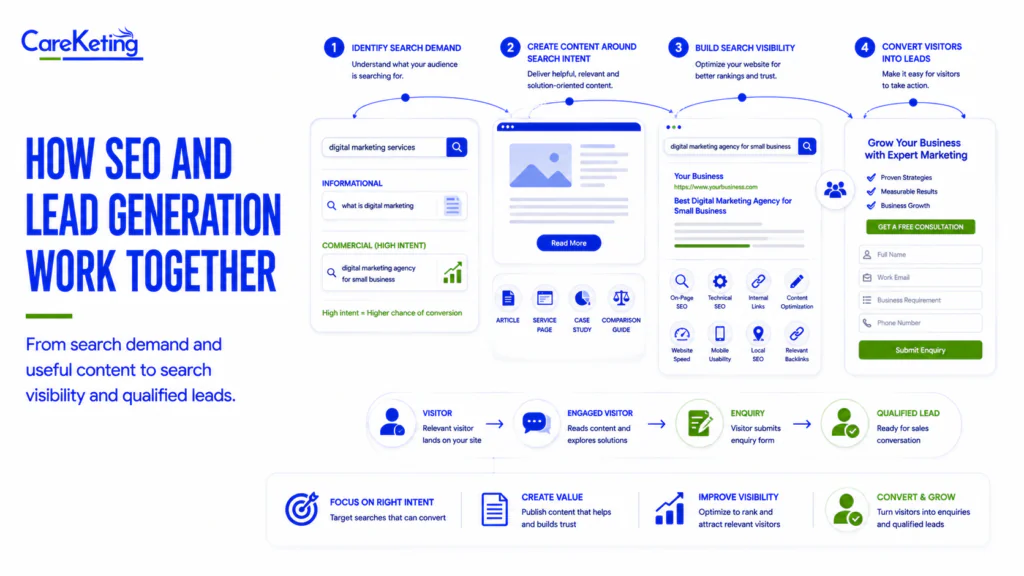
A successful organic lead generation process usually has four stages.
1. Identify Search Demand
Start with keyword research.
Look for searches your target audience actually uses. These can include informational keywords, commercial keywords, local searches, and high intent phrases.
For example, someone searching “what is digital marketing” is probably researching.
Someone searching “digital marketing agency for small business” may have stronger commercial intent.
Understanding this difference is essential for SEO and lead generation.
2. Create Content Around Search Intent
Once you understand the search, create content that genuinely answers it.
A beginner may need an educational article. A potential buyer may need a service page, comparison, case study, pricing information, or product specification.
Good SEO content should answer the question clearly instead of simply repeating keywords.
3. Build Search Visibility
Your website needs a technically sound foundation.
Important areas include:
- On page SEO
- Technical SEO
- Internal linking
- Content optimization
- Website speed
- Mobile usability
- Local SEO
- Relevant backlinks
These elements help search engines understand your website and help users navigate it.
4. Convert Visitors Into Leads
This is where many SEO campaigns lose their business value.
A visitor reaches your website but cannot find a clear next step.
Effective SEO and lead generation requires relevant calls to action, simple forms, visible contact information, enquiry buttons, useful landing pages, and a clear conversion path.
7 SEO Strategies for Quality Lead Generation
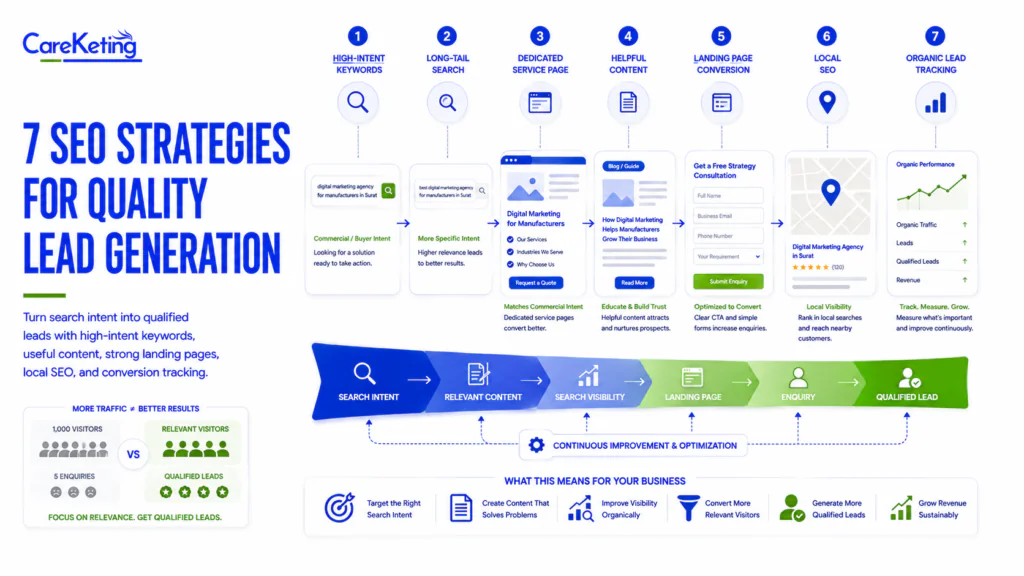
1. Target High Intent Keywords
Not every keyword has the same business value.
Terms containing words such as “buy,” “price,” “supplier,” “agency,” “service,” or “near me” can indicate stronger commercial intent depending on the industry.
2. Use Long Tail Keywords
Long tail keywords are often more specific.
Instead of targeting “digital marketing,” a business might target “digital marketing agency for manufacturers in Surat.”
The search volume may be lower, but the relevance can be much higher.
3. Build Dedicated Service Pages
A general homepage should not have to answer every customer question.
Create dedicated pages for important services, products, locations, and customer segments.
This gives search engines and visitors clearer information.
4. Create Helpful Educational Content
Blog content can attract people earlier in the customer journey.
For instance, a financial services company could publish an article explaining business loan eligibility and then guide relevant readers toward a consultation page.
This creates a natural SEO conversion funnel.
5. Improve Landing Page Conversion
Ranking brings visitors. Conversion optimization helps turn those visitors into leads.
Review your headlines, forms, calls to action, trust signals, testimonials, product information, and page structure.
A page receiving 1,000 visitors and generating five enquiries may need conversion work before additional SEO investment.
6. Use Local SEO
For businesses serving specific cities or regions, local SEO can be particularly valuable.
A local service company could optimize its website and business profile for searches related to its service and location.
This can bring highly relevant local traffic instead of general visitors from across the country.
7. Track Organic Leads
Do not measure SEO only through rankings.
Track:
- Organic traffic
- Leads generated
- Qualified leads
- Conversion rate
- Lead source
- Cost of acquisition
- Revenue from organic customers
This gives a more realistic picture of SEO and lead generation performance
Common Mistakes in SEO Lead Generation
Chasing Traffic Instead of Buyers
High traffic does not always mean high business value.
Targeting Extremely Broad Keywords
Broad keywords can be competitive and may attract people with little buying intent.
Ignoring Conversion Optimization
Good rankings cannot compensate for a confusing website.
Publishing Without a Strategy
Random articles rarely create a strong organic acquisition system.
Expecting Immediate Results
SEO often requires consistent work before meaningful results appear. Rankings can also fluctuate, so performance should be evaluated over a reasonable period.
Frequently Asked Questions
How does SEO help with lead generation?
SEO attracts people who are actively searching for relevant information, products, or services. Optimized pages can then guide those visitors toward enquiries and other conversions.
Is SEO better than paid advertising for lead generation?
Neither is automatically better. Paid advertising can provide faster visibility, while SEO can build sustainable organic search traffic. The right mix depends on the business and its objectives.
What keywords are best for SEO lead generation?
High intent commercial keywords are often valuable, but informational and long tail keywords can also contribute by attracting prospects earlier in the buying journey.
How long does SEO take to generate leads?
There is no fixed timeline. Results depend on competition, website authority, content quality, technical health, search demand, and the consistency of SEO work.
Can small businesses use SEO for lead generation?
Yes. Small businesses can focus on specific services, locations, customer problems, and long tail searches rather than competing for broad national keywords.
Conclusion
SEO and lead generation should not be treated as two separate marketing activities. SEO creates opportunities by bringing relevant people to your website, while lead generation gives those visitors a clear reason and path to contact your business.
The strongest approach starts with customer research and search intent. From there, businesses can create useful content, optimize service pages, improve technical performance, strengthen local visibility, and continuously improve conversion rates.
The goal is simple: attract the right searcher, answer their question, build enough trust, and make the next step easy.
Start by checking your website’s top organic landing pages. Ask one practical question for each page: Does this page give the visitor a clear reason to contact us? If the answer is no, that is often the first SEO conversion improvement worth making.