
Performance Marketing: Meaning, Types, Strategies, Benefits & Examples
A practical guide to performance marketing, including how it works, common models, useful strategies, benefits, metrics, and real business examples.
Introduction
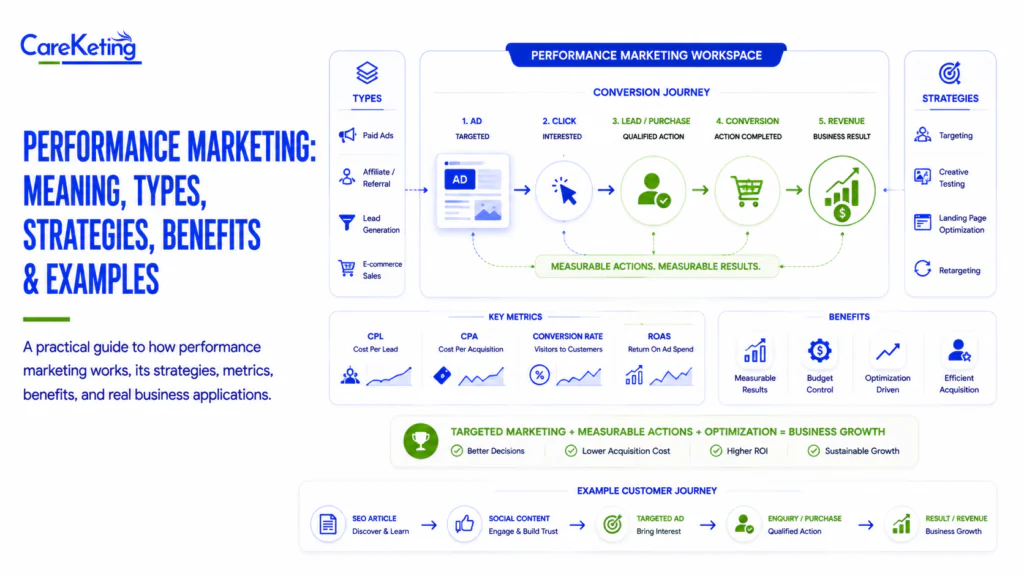
A business can spend money on advertising without knowing exactly what that spending produced. Performance marketing takes a different approach. It focuses heavily on measurable actions such as leads, sales, clicks, app installs, or customer acquisitions.
For example, a local service business may run an advertising campaign and measure the number of qualified enquiries generated from it. An ecommerce company may focus on purchases and revenue. A B2B manufacturer may track leads and the percentage that eventually become customers.
The basic idea behind performance marketing is simple: connect marketing spending with measurable business outcomes.
Table of Contents
What Is Performance Marketing?
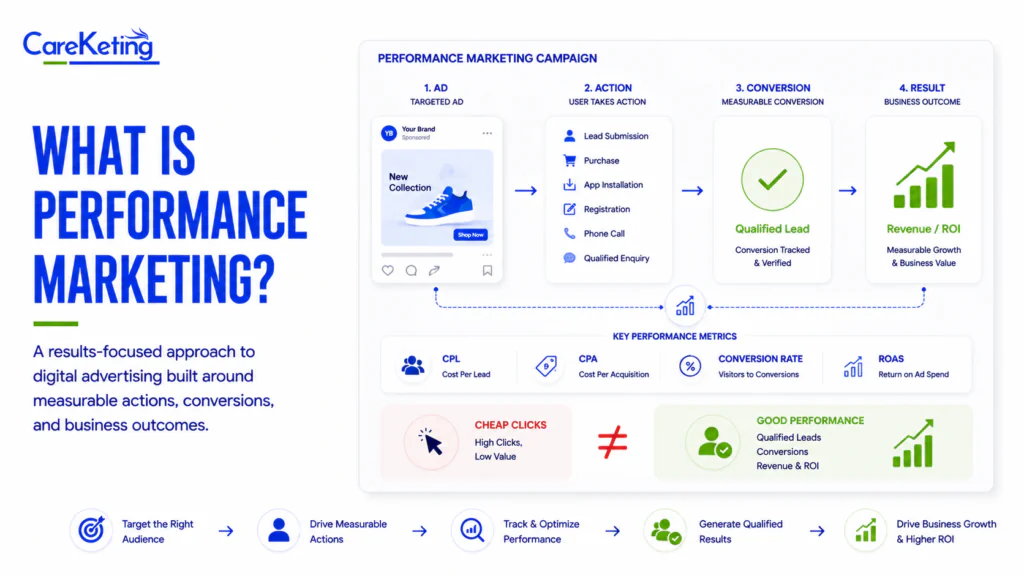
Performance marketing is a form of digital marketing where campaigns are planned, tracked, and optimized around measurable actions.
Depending on the business, the desired action could be:
- A qualified lead
- A product purchase
- A website conversion
- An app installation
- A completed registration
- A phone call
- A subscription
This makes performance based marketing different from campaigns focused mainly on visibility or brand exposure.
However, this does not mean every campaign should be judged only by immediate sales. Brand awareness can influence future conversions. The important point is to define the business objective and measure the right indicators.
How Does Performance Marketing Work?
A typical performance marketing strategy follows a straightforward process.
1. Define the Objective
First decide what the campaign needs to achieve.
A real estate business may want enquiries. An ecommerce store may want purchases. A B2B company may want qualified decision makers to submit an enquiry.
2. Select the Right Channel
Businesses can use paid search marketing, social media advertising, affiliate marketing, display advertising, or other digital advertising channels.
The choice should depend on where the target audience spends time and what type of action you need.
3. Set Up Tracking
Conversion tracking is critical.
Without proper tracking, you may know that an advertisement received clicks but not whether those clicks produced useful business results.
4. Optimize the Campaign
Campaign performance is reviewed regularly.
Advertisers can compare audiences, creative formats, landing pages, keywords, offers, and placements to identify what is producing better results.
This is where data driven marketing becomes practical.
Types of Performance Marketing
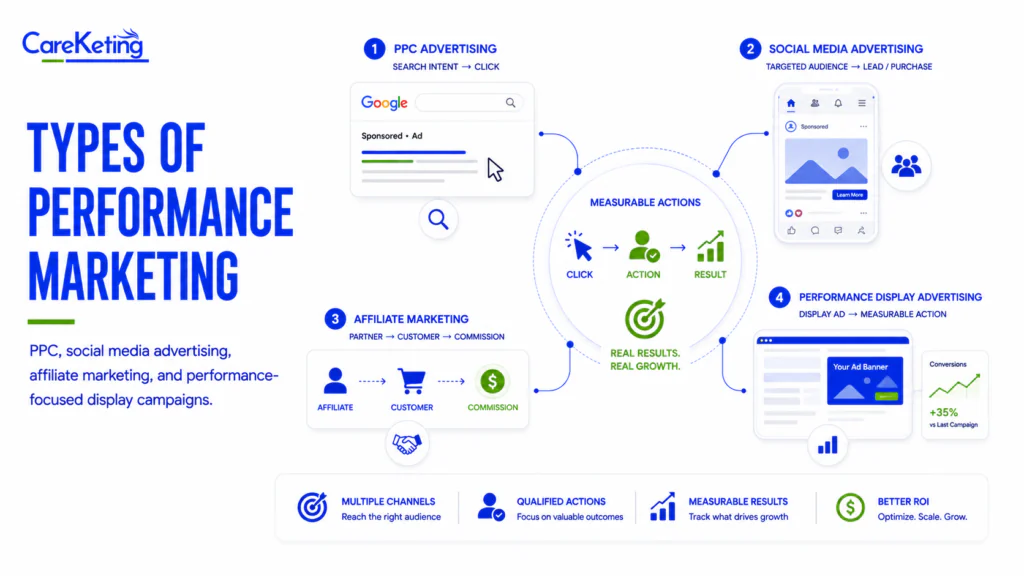
Pay Per Click Advertising
With PPC advertising, advertisers generally pay when someone clicks an advertisement.
Search campaigns are useful when people are actively looking for a product or service.
Social Media Advertising
Platforms such as Facebook and Instagram can help businesses reach selected audiences and optimize campaigns for actions such as leads, traffic, or purchases.
Affiliate Marketing
In affiliate marketing, partners promote a company’s products or services and receive compensation based on agreed results.
Performance Display Advertising
Display campaigns can be optimized toward measurable actions rather than simply impressions.
The exact payment and measurement model depends on the campaign structure.
7 Practical Performance Marketing Strategies
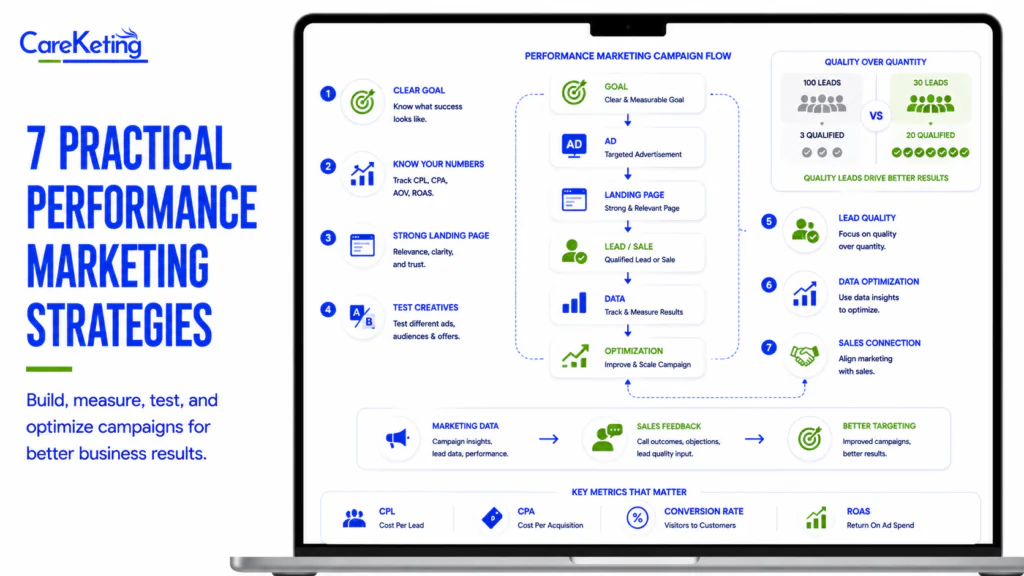
1. Start With One Clear Goal
Do not optimize one campaign for everything.
Choose a primary outcome such as leads, sales, or registrations.
2. Know Your Numbers
Before launching, understand your acceptable cost per lead, cost per acquisition, average order value, and expected profit.
This prevents a campaign from appearing successful simply because it generated cheap clicks.
3. Use Strong Landing Pages
An advertisement may attract the right person, but a confusing landing page can lose the opportunity.
Keep the message relevant, explain the offer clearly, and make the next step simple.
4. Test Multiple Creatives
Different audiences respond to different messages.
Test headlines, images, videos, offers, and calls to action rather than assuming one creative will work indefinitely.
5. Track Lead Quality
This is especially important for B2B companies.
A campaign generating 100 leads may look impressive. If only three are genuinely relevant, the campaign may be weaker than one producing 30 highly qualified leads.
6. Optimize Based on Data
Look beyond surface metrics.
Compare conversion rate, cost per acquisition, lead quality, revenue, and return on investment.
7. Connect Marketing With Sales
For lead generation campaigns, marketing should not operate in isolation.
Sales feedback can reveal whether leads have the right budget, requirement, location, or buying intent. That information can then improve campaign targeting.
Benefits of Performance Marketing
The biggest advantage of performance marketing is measurable decision making.
Businesses can identify which campaigns generate results and where money is being wasted.
Other benefits include:
- Better campaign performance tracking
- Clearer marketing KPIs
- More controlled advertising budgets
- Faster campaign testing
- Better audience targeting
- Improved conversion opportunities
- Easier ROI measurement
Still, performance marketing is not a guarantee of profitability. Poor tracking, weak offers, low quality leads, or unrealistic targets can produce misleading results.
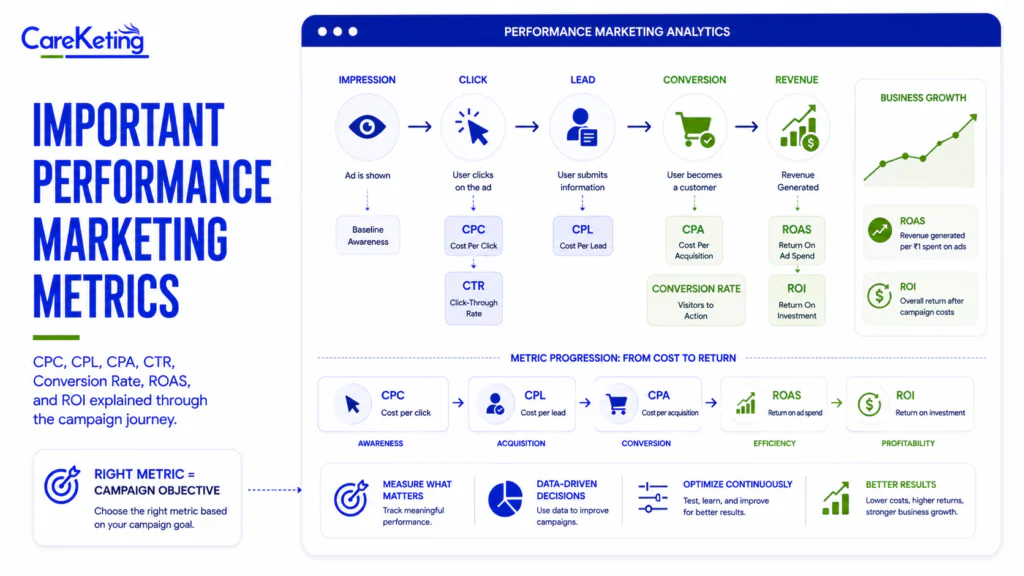
Important Performance Marketing Metrics
Some commonly used metrics include:
Metric | What It Tells You |
CPC | Cost of generating a click |
CPL | Cost of generating a lead |
CPA | Cost of acquiring a customer or desired action |
CTR | How often people click after seeing an ad |
Conversion Rate | Percentage of visitors completing an action |
ROAS | Revenue generated relative to advertising spend |
ROI | Overall return after considering relevant costs |
The right metric depends on the campaign objective.
Real World Example
Imagine a lubricant manufacturer wants distributor enquiries.
The company could run paid social media advertising targeting people involved in distribution and wholesale businesses. Instead of measuring success only through clicks, the company can track enquiries, distributor eligibility, sales conversations, and eventual conversions.
Suppose one campaign generates fewer leads but those leads consistently become serious distributor discussions. That campaign may deserve more budget than a campaign producing twice as many low quality enquiries.
That is the practical value of performance marketing.
Common Mistakes
Focusing Only on Cheap Leads
A low CPL does not automatically mean a successful campaign.
Ignoring Conversion Tracking
Without reliable tracking, optimization becomes guesswork.
Changing Campaigns Too Frequently
Campaigns need enough data before meaningful decisions can be made.
Measuring Vanity Metrics
Impressions and likes can provide useful context, but they should not replace business outcomes when direct response is the objective.
Frequently Asked Questions
What is performance marketing in simple words?
Performance marketing is marketing focused on measurable actions such as leads, sales, clicks, registrations, or customer acquisitions.
What are the main types of performance marketing?
Common types include PPC advertising, paid social media advertising, affiliate marketing, display advertising, and other measurable digital advertising campaigns.
Is performance marketing suitable for small businesses?
Yes. Small businesses can use it when they have a clearly defined goal, appropriate tracking, a realistic budget, and an offer that matches customer demand.
What is the difference between performance marketing and digital marketing?
Digital marketing is the broader category. Performance marketing is a results focused approach within digital marketing that emphasizes measurable actions and campaign outcomes.
Which metrics should businesses track?
Depending on the objective, businesses may track CPC, CPL, CPA, conversion rate, ROAS, ROI, qualified leads, sales, and revenue.
Conclusion
Performance marketing gives businesses a practical framework for connecting advertising activity with measurable outcomes. Instead of asking only how many people saw an advertisement, marketers can ask a more useful question: what did that marketing activity actually produce?
The strongest campaigns combine accurate tracking, relevant targeting, useful creative, effective landing pages, and continuous optimization.
For a small business, the goal should not be to chase every available metric. Start with one meaningful business outcome, measure it properly, and improve the campaign based on evidence.
If you are planning a performance campaign, begin by defining your target action and acceptable acquisition cost. That simple exercise can make your advertising decisions much clearer.