Performance Marketing vs Digital Marketing: Key Differences, Benefits & Examples
A simple guide to understanding the difference between performance marketing and digital marketing, including their goals, channels, benefits, and practical business examples.
Introduction
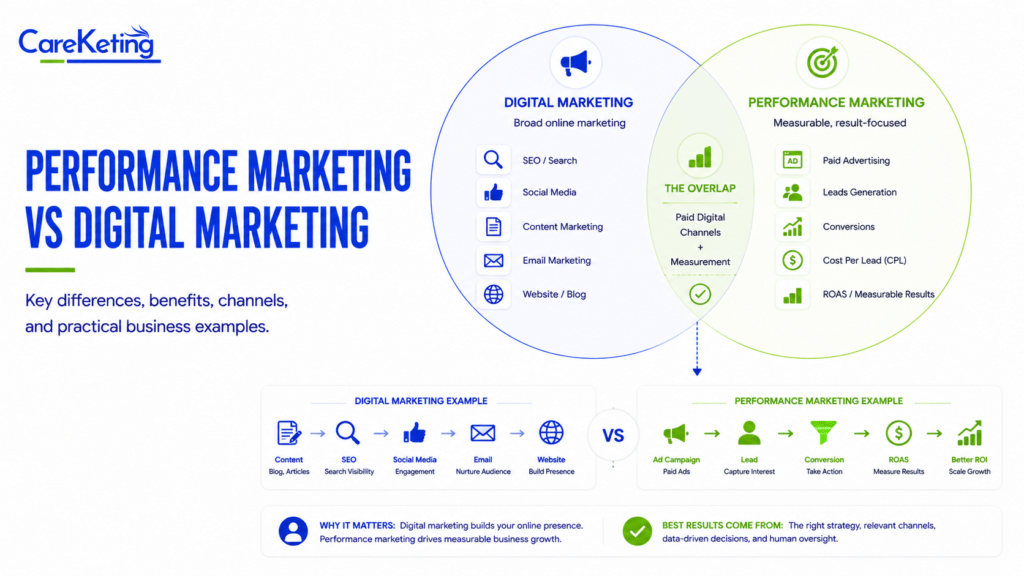
Many business owners use the terms digital marketing and performance marketing as if they mean the same thing. They are closely connected, but they are not identical.
Understanding performance marketing vs digital marketing becomes important when you are deciding where to spend your marketing budget. Digital marketing covers a broad range of online activities, including SEO, social media, content, email, websites, and paid advertising. Performance marketing focuses more strongly on measurable actions such as leads, sales, registrations, or customer acquisition.
For example, a business may use SEO to build organic traffic over time while using paid advertising to generate enquiries this month. Both are digital marketing activities, but the way they are planned and measured can be very different.
Table of Contents
What Is Digital Marketing?
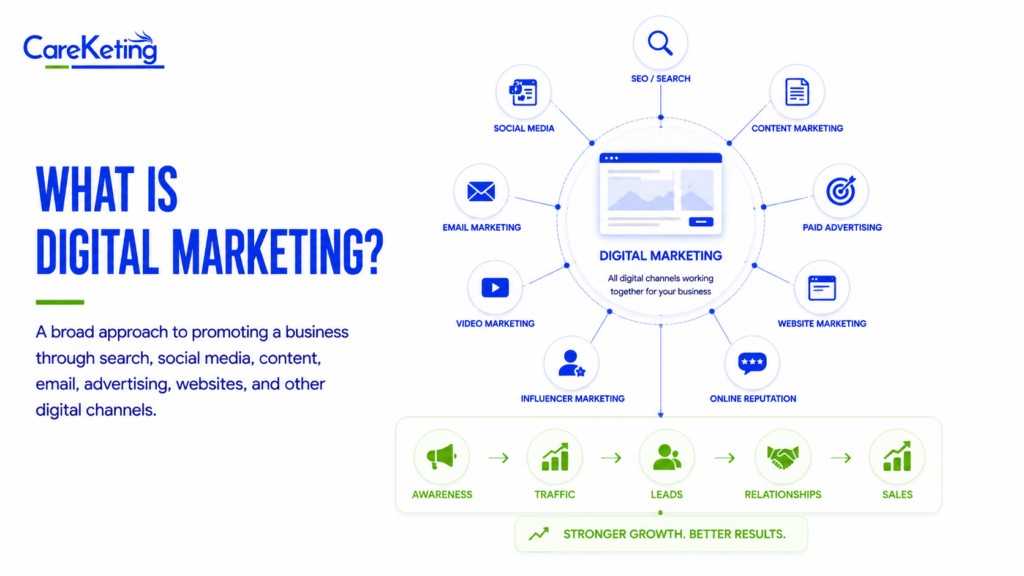
Digital marketing is the broader process of promoting a business through digital channels.
It can include:
- Search engine optimization
- Social media marketing
- Content marketing
- Email marketing
- Paid advertising
- Influencer marketing
- Video marketing
- Website marketing
- Online reputation management
The objective can vary. A company may want to increase brand awareness, attract website visitors, generate leads, build customer relationships, or increase sales.
This makes digital marketing a broad business function rather than one specific advertising method.
What Is Performance Marketing?
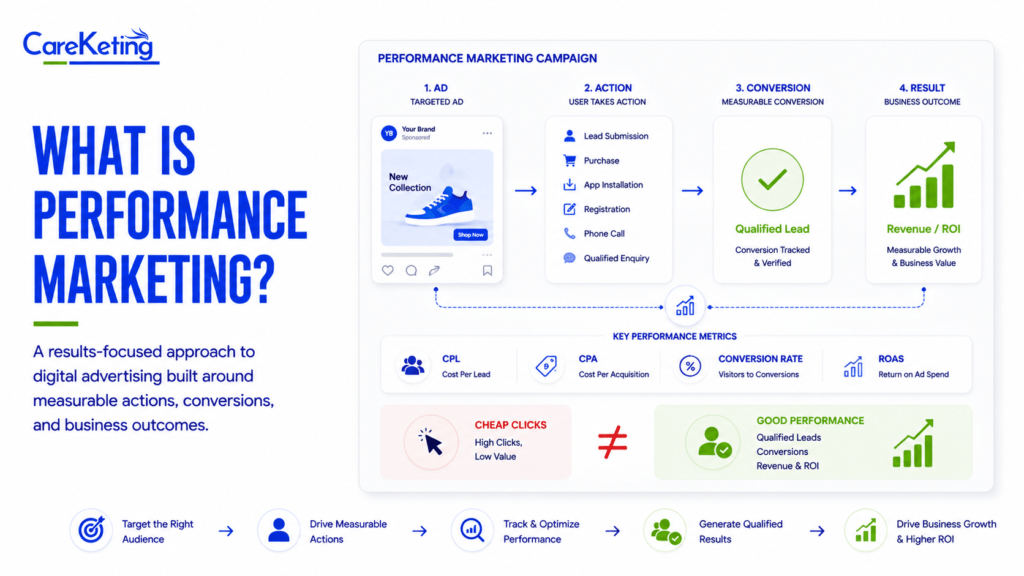
Performance marketing is a more results focused approach to digital advertising and customer acquisition.
Instead of focusing primarily on exposure, campaigns are planned around measurable actions.
These actions can include:
- Lead submissions
- Product purchases
- App installations
- Registrations
- Phone calls
- Qualified enquiries
- Customer acquisitions
A business might therefore measure cost per lead, cost per acquisition, conversion rate, revenue, or return on investment.
The important point is that performance marketing is not simply about getting cheap clicks. A campaign that generates inexpensive but irrelevant leads can still be a poor campaign.
Performance Marketing vs Digital Marketing: The Key Difference
The simplest way to understand performance marketing vs digital marketing is this:
Digital marketing is the broader category, while performance marketing is a results focused approach that can operate within digital marketing.
Consider SEO.
A company may publish useful articles to increase organic traffic and improve search visibility. The long term objective could be brand authority and consistent website traffic.
A performance campaign, on the other hand, may focus on generating 50 qualified enquiries at an acceptable acquisition cost.
Both can contribute to business growth, but their objectives and measurement methods differ.
Performance Marketing vs Digital Marketing Comparison
Factor | Digital Marketing | Performance Marketing |
Scope | Broad | More focused |
Main goals | Awareness, traffic, leads, sales and retention | Measurable actions and conversions |
Channels | SEO, social, email, content, paid media and more | Paid search, social ads, affiliate and other measurable channels |
Measurement | Depends on objective | Strong focus on measurable outcomes |
Time horizon | Short or long term | Often focused on measurable campaign results |
Common KPIs | Traffic, engagement, reach, rankings, leads and sales | CPL, CPA, conversion rate, revenue and ROAS |
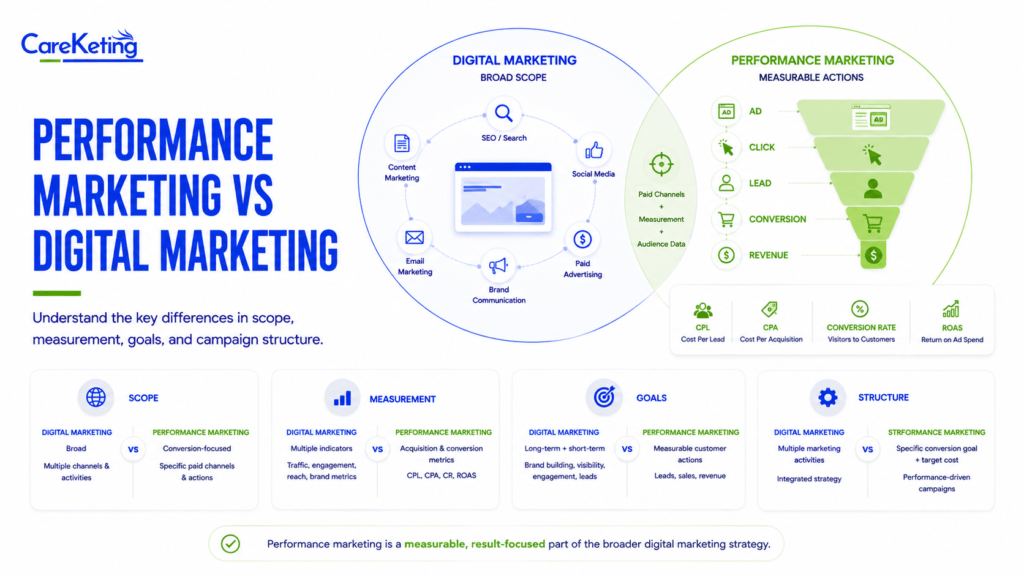
Main Differences Between Performance and Digital Marketing
1. Scope
Digital marketing includes both organic and paid marketing activities.
Performance marketing usually focuses more heavily on campaigns where actions can be tracked and attributed.
2. Measurement
Digital marketing can measure many indicators, including website traffic, social engagement, search rankings, email opens, leads, and sales.
Performance marketing places greater emphasis on conversion tracking and acquisition metrics.
3. Marketing Goals
Digital marketing may support long term brand building.
Performance marketing is generally more closely connected to immediate or measurable customer actions.
4. Campaign Structure
A digital marketing strategy may involve content calendars, SEO planning, social media management, email campaigns, and brand communication.
A performance campaign usually begins with a specific conversion goal and an acceptable cost for achieving it.
Practical Example: B2B Manufacturer
Imagine a manufacturer wants to expand its distributor network.
Its digital marketing strategy could include SEO articles, social media content, a professional website, product videos, and email communication.
At the same time, the company could run performance marketing campaigns targeting potential distributors.
The first activity builds visibility and credibility. The second focuses on measurable enquiries.
This combination is often more useful than choosing one approach and ignoring the other.
Practical Example: Local Service Business
A local home repair company could use SEO to appear when people search for relevant services.
It could also run paid social advertising with a direct enquiry objective.
SEO may bring visitors over time, while paid advertising can provide faster opportunities to generate leads.
The business should evaluate both based on their actual contribution rather than assuming one channel is automatically better.
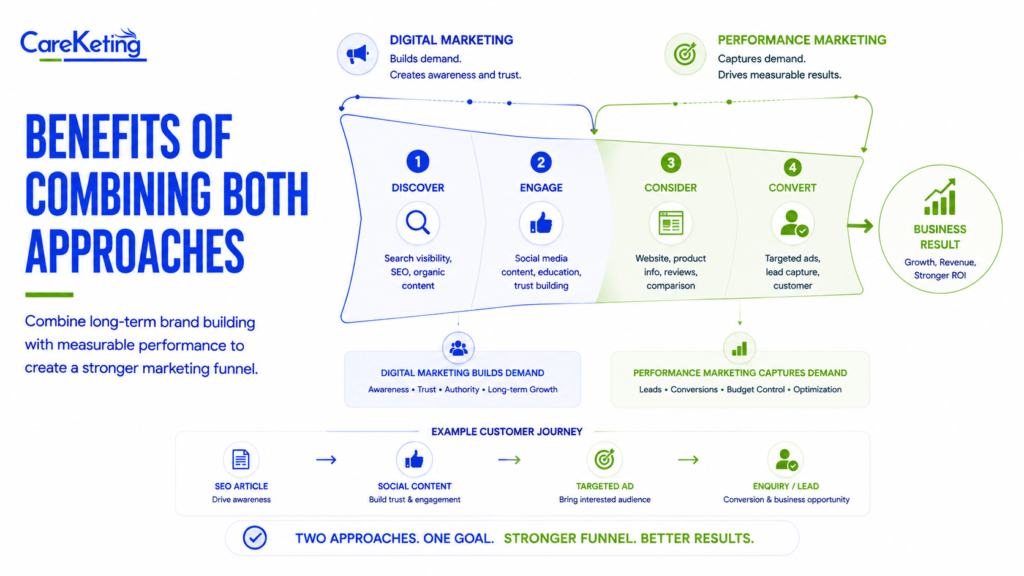
Benefits of Combining Both Approaches
The debate around performance marketing vs digital marketing can sometimes make businesses feel they need to choose one.
In practice, they often work better together.
Digital marketing can help with:
- Brand awareness
- Search visibility
- Customer education
- Trust building
- Organic traffic
- Long term brand development
Performance marketing can help with:
- Lead generation
- Customer acquisition
- Conversion focused campaigns
- Budget control
- Measurable results
- Campaign optimization
A strong marketing funnel can use both. Someone may first discover a business through an SEO article, later see its social content, and eventually respond to a targeted advertisement.
Which One Should Your Business Use?
There is no universal answer.
If your business needs long term visibility and brand authority, broader digital marketing activities are important.
If you need measurable leads or sales and have a clear offer, performance marketing may deserve greater attention.
For many small and medium businesses, a balanced approach works best. Build organic visibility while using paid campaigns where immediate customer acquisition makes financial sense.
Common Mistakes
Treating Every Click as a Result
Clicks are useful, but they do not necessarily create revenue.
Ignoring Brand Building
Not every customer converts immediately. Trust can influence future purchasing decisions.
Tracking Too Many Metrics
Choose KPIs that connect directly to your marketing objectives.
Expecting Instant SEO Results
Organic marketing often requires consistent work before meaningful results appear.
Judging Channels Without Business Context
A channel producing fewer leads may still be more valuable if those leads have a much higher conversion rate.
Frequently Asked Questions
Is performance marketing part of digital marketing?
Yes. Performance marketing can be considered a results focused approach within the wider digital marketing ecosystem.
What is the difference between performance marketing and digital marketing?
Digital marketing covers a broad range of online marketing activities. Performance marketing focuses more specifically on measurable actions such as leads, sales, and customer acquisition.
Is SEO performance marketing?
SEO can be measured through traffic, rankings, conversions, and revenue. However, SEO is generally considered a digital marketing channel rather than automatically being performance marketing.
Which is better for lead generation?
Performance marketing can be useful when a business wants measurable lead generation. However, SEO, content, social media, and other digital channels can also contribute to generating qualified leads.
Can small businesses use both?
Yes. A small business can use organic channels for long term visibility and paid performance campaigns for targeted customer acquisition.
Conclusion
Understanding performance marketing vs digital marketing is less about choosing a winner and more about understanding their roles.
Digital marketing provides the broader framework for building visibility, attracting audiences, educating customers, and developing a brand. Performance marketing places stronger emphasis on measurable actions, acquisition costs, conversion rates, and financial outcomes.
For most businesses, the strongest strategy is not either or. It is a sensible combination of organic marketing, brand building, paid media, conversion tracking, and continuous optimization.
Before choosing a marketing channel, define the business result you want first. Once the goal is clear, selecting the right channel and measurement method becomes much easier.