
Marketing 7C: The 7 Cs of Marketing Explained with Examples
A practical guide to the Marketing 7C framework, its seven principles, real business examples, and how to use it for better customer focused marketing.
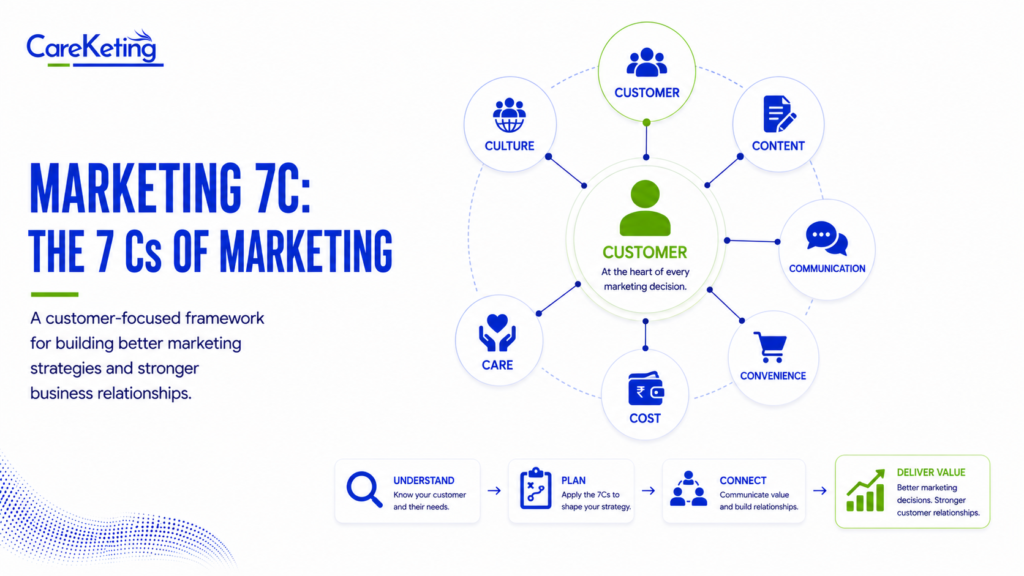
Introduction
A good marketing strategy is not only about having the right product or running advertisements. It also depends on how well a business understands its customers, communicates with them, delivers value, and builds relationships.
The Marketing 7C framework provides a useful way to look at these areas together. The 7C marketing model is a customer focused framework that can help businesses think beyond products and promotional activities.
For a small business, this can be particularly useful. Before spending money on advertising, the business can ask simple questions: Who is the target customer? What does that customer actually need? Is the buying process convenient? Is communication clear? Are customers receiving proper care after the sale?
These questions form the foundation of the Marketing 7C approach.
Table of Contents
What Is the Marketing 7C Model?
The Marketing 7C model is a marketing planning framework that places the customer and business relationship at the center of decision making.
Different sources may describe or organize the seven Cs differently. A practical customer focused interpretation includes:
- Customer
- Content
- Communication
- Convenience
- Cost
- Care
- Culture
The purpose is not to memorize seven words. The real value comes from using them as questions when developing a marketing strategy.
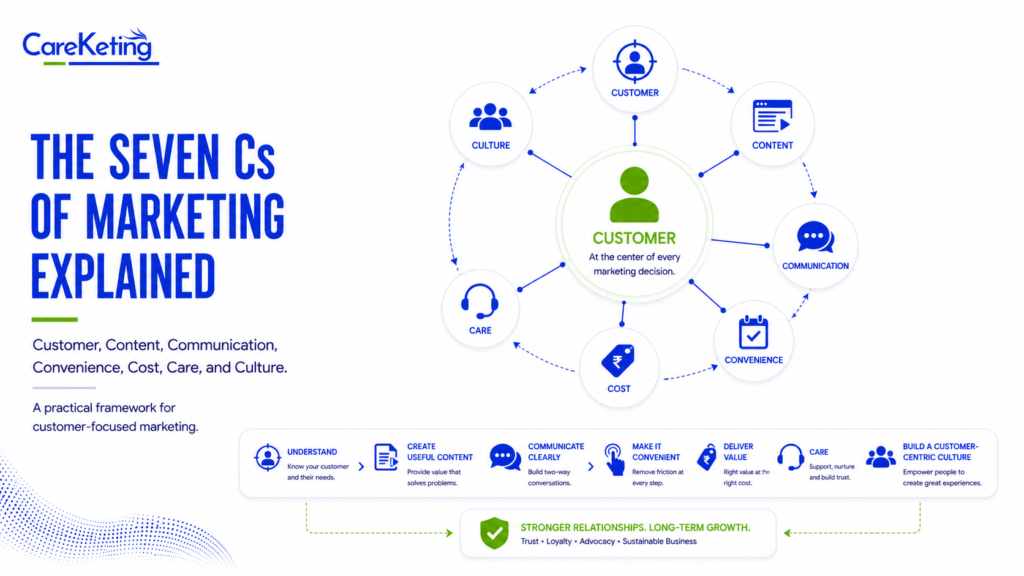
The Seven Cs of Marketing Explained
1. Customer
Everything begins with the customer.
A business should understand its target customer’s needs, problems, preferences, budget, and buying behavior.
For example, a manufacturer selling industrial lubricants to distributors should not communicate in exactly the same way as a company selling engine oil directly to individual vehicle owners.
Practical question: Who exactly are we trying to serve?
2. Content
Content explains why customers should pay attention to your business.
It can include educational articles, product demonstrations, videos, case studies, social media posts, guides, and frequently asked questions.
A B2B manufacturer could create content explaining how distributors can select the right lubricant range for different customers.
Useful content should answer genuine customer questions rather than simply promote the company.
3. Communication
Communication is about how a business presents information and maintains conversations with customers.
Your website, advertisements, sales team, social media accounts, WhatsApp messages, and emails should not give completely different impressions.
Clear communication builds confidence.
For instance, if an advertisement promises quick enquiry support but customers receive no response for two days, the communication strategy has failed.
4. Convenience
Customers value simplicity.
Convenience can involve easy navigation, straightforward enquiry forms, multiple payment options, quick responses, simple booking processes, or accessible customer support.
A local service business can improve its customer experience simply by making appointment booking easier.
Practical question: How much effort does the customer need to make to buy from us?
5. Cost
Price is important, but the Marketing 7C perspective encourages businesses to think about the customer’s total perceived cost.
This can include money, time, effort, delivery charges, waiting periods, installation, maintenance, or risk.
A product with a slightly higher price may still be attractive if it offers better support, reliability, or convenience.
6. Care
Marketing should not stop when the customer makes a purchase.
Customer care includes support, complaint handling, follow up communication, warranty assistance, and maintaining relationships.
This is especially important for B2B businesses where repeat purchases and long term relationships can have significant value.
A customer who receives reliable support is more likely to trust the business again.
7. Culture
Culture refers to the values and behavior within the company.
If a business claims that customer satisfaction matters but employees ignore customer complaints, the marketing message loses credibility.
Strong company culture supports consistent customer experiences.
This is one reason customer centric marketing cannot be treated as only an advertising activity.
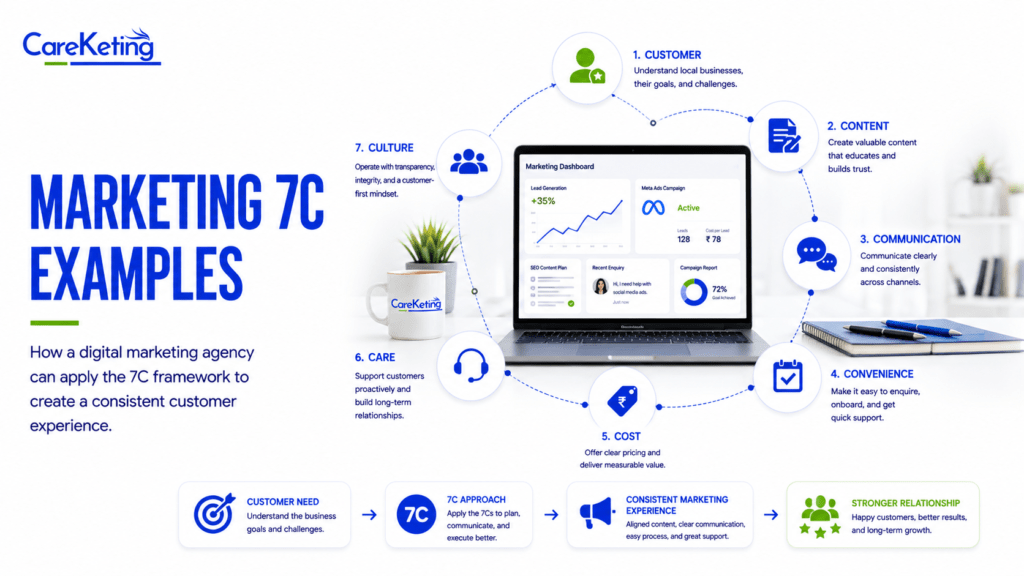
Marketing 7C Examples
Consider a small digital marketing agency.
Its Customer could be local businesses that need consistent lead generation.
Its Content could include practical articles about Meta Ads, SEO, and lead generation.
Its Communication could focus on simple explanations instead of technical jargon.
Its Convenience could include easy enquiry and onboarding processes.
Its Cost could be presented clearly with no confusing charges.
Its Care could involve regular campaign updates and support.
Its Culture could emphasize transparency and realistic expectations.
When these areas work together, marketing becomes more consistent.
How to Use the 7C Marketing Framework
A simple approach is to review your business using seven questions:
C | Key Question |
Customer | Who are we serving? |
Content | What useful information do they need? |
Communication | Are we explaining our value clearly? |
Convenience | Is buying or contacting us easy? |
Cost | Does the overall value justify the customer’s investment? |
Care | What happens after the sale? |
Culture | Do our internal actions match our brand promise? |
This exercise can reveal problems that an advertising campaign alone cannot fix.
Common Marketing 7C Mistakes
Focusing Only on Promotion
A business cannot solve a weak product or poor customer experience simply by increasing advertising spend.
Ignoring Existing Customers
Acquiring customers matters, but retaining good customers can also create substantial business value.
Using Generic Communication
Different audiences have different concerns. A distributor, consumer, and business owner may require completely different messages.
Making Convenience an Afterthought
A difficult enquiry process can waste the attention generated by good marketing.
Frequently Asked Questions
What is the Marketing 7C model?
The Marketing 7C model is a customer focused marketing framework used to evaluate important areas such as customer needs, content, communication, convenience, cost, care, and company culture.
What are the seven Cs of marketing?
A practical version of the seven Cs includes Customer, Content, Communication, Convenience, Cost, Care, and Culture.
Why is the 7C marketing model important?
It helps businesses look at marketing from the customer’s perspective rather than focusing only on products, advertising, or pricing.
How can small businesses use the 7C framework?
Small businesses can use the framework to review their target audience, communication, customer experience, buying process, pricing, support, and internal company values.
Is Marketing 7C better than the traditional marketing mix?
They serve different purposes. Traditional marketing mix frameworks focus on areas such as product, price, place, and promotion. The 7C approach provides a more customer focused way to evaluate the overall marketing experience.
Conclusion
The Marketing 7C framework provides a practical way to examine marketing beyond advertisements and social media posts. It encourages businesses to understand customers, create useful content, communicate clearly, reduce buying friction, provide fair value, care for customers, and build an internal culture that supports the brand promise.
For small businesses especially, these principles can expose simple problems that are often overlooked. Sometimes the answer is not another advertisement. It may be a clearer offer, faster response, easier enquiry process, or better customer support.
Before launching your next marketing campaign, review your business through the seven Cs. It can help you identify what needs improvement before you increase your marketing budget.