
AI and Digital Marketing: How Artificial Intelligence Is Transforming Marketing
A practical guide to AI in digital marketing, including automation, personalization, content creation, SEO, advertising, lead generation, and real business use cases.
Introduction
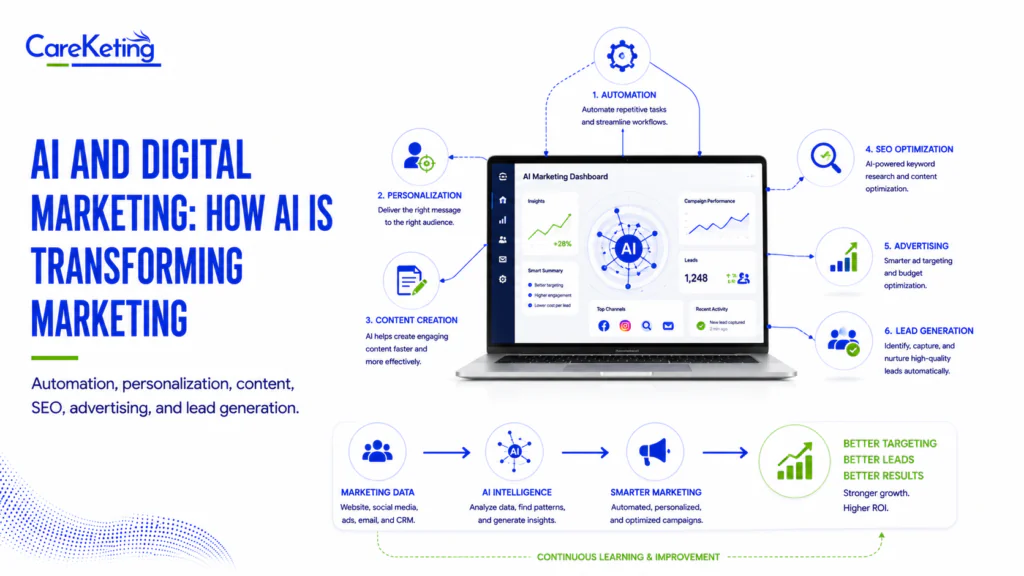
Marketing has always depended on understanding people. What do customers want? Which message gets their attention? What makes them trust a business? AI and digital marketing are changing how marketers answer these questions.
Artificial intelligence can process large amounts of customer data, identify patterns, generate content ideas, automate repetitive tasks, and help marketers make faster decisions. However, AI does not replace good marketing strategy. It works best when businesses use technology to support human judgment.
For a small business, AI and digital marketing can mean faster content research, better audience analysis, automated customer responses, and more efficient campaign management.
Table of Contents
What Is AI and Digital Marketing?
AI and digital marketing refers to using artificial intelligence technologies in digital marketing activities such as customer analysis, content creation, advertising, SEO, personalization, automation, and campaign optimization.
Traditional marketing decisions often depend on manual research and historical data. AI can analyze much larger datasets and identify patterns more quickly.
For example, an ecommerce business can analyze customer behavior and identify products that different groups are likely to purchase. A service business can use an AI chatbot to answer common questions before a sales representative becomes involved.
The purpose is not simply automation. Good AI and digital marketing should help marketers make better decisions and create more relevant customer experiences.
How AI Is Changing Digital Marketing
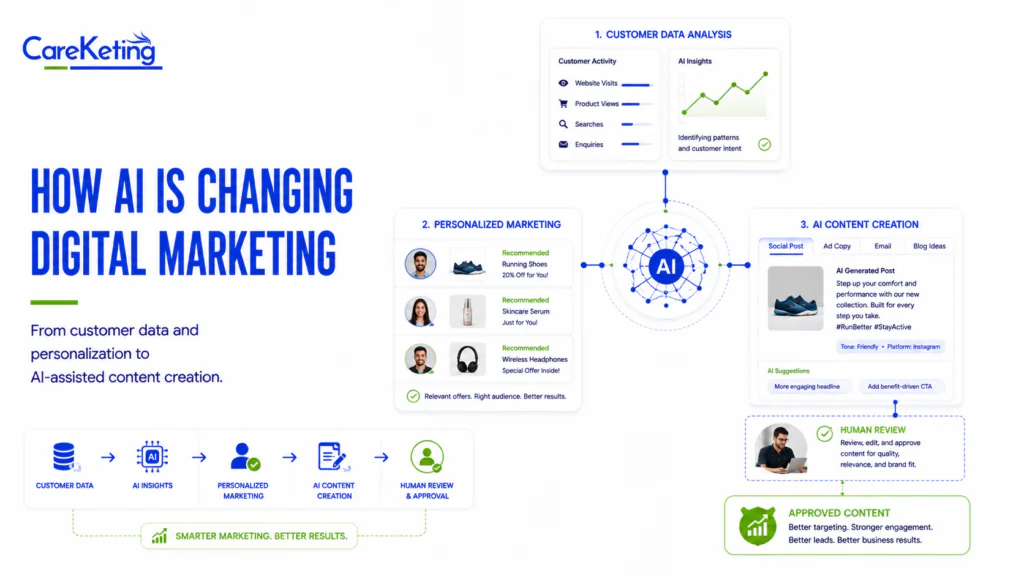
1. Customer Data Analysis
One of the most useful applications of AI and digital marketing is customer behavior analysis.
AI systems can process information such as website visits, search behavior, purchase history, campaign interactions, and customer enquiries. This can help businesses understand audience segments and identify patterns that may be difficult to spot manually.
For example, a manufacturer may discover that visitors who repeatedly view a particular product page are more likely to submit an enquiry.
2. Personalized Marketing
Customers do not all respond to the same message.
AI can help businesses create personalized marketing experiences based on customer interests, previous interactions, location, or buying behavior.
An online store might recommend different products to different visitors. An email campaign can also use customer information to provide more relevant product suggestions.
3. AI Content Creation
Generative AI can assist with content research, outlines, social media ideas, product descriptions, email drafts, and advertising variations.
However, marketers should not publish AI generated content without review.
Experience, original insights, accurate information, and a clear understanding of the customer still matter. AI should assist the content process rather than remove human responsibility.
AI and Digital Marketing for SEO
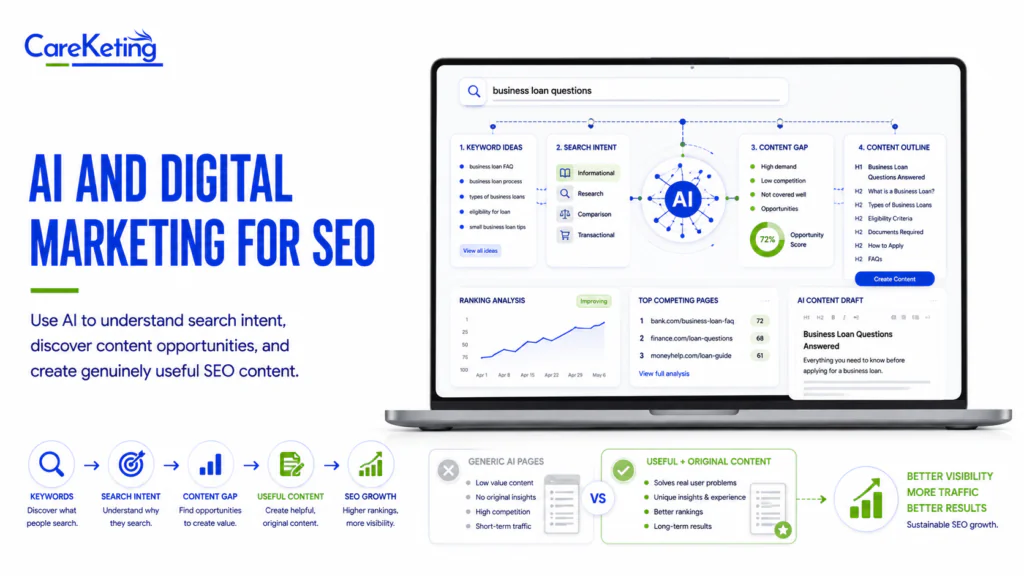
Search engine optimization is another area where AI and digital marketing are becoming closely connected.
AI SEO tools can help marketers analyze keywords, understand search intent, identify content gaps, organize topics, and review existing pages.
For example, a marketing agency might use AI to identify questions customers commonly ask about business loans. The marketer can then create a useful article answering those questions.
The important distinction is quality. Using AI to produce large quantities of generic pages is not a substitute for useful, original content.
AI and Digital Marketing for Advertising
Advertising platforms already use machine learning to process signals and improve campaign delivery.
Marketers can use AI assisted tools to generate creative variations, analyze campaign performance, identify audience patterns, and test different messages.
Consider a local service business running lead generation campaigns. Instead of manually reviewing every interaction, AI powered analytics can help identify which audience groups, messages, or placements are producing better results.
Still, campaign optimization requires human oversight. A low cost lead is not necessarily a valuable lead.
AI for Lead Generation and Customer Engagement
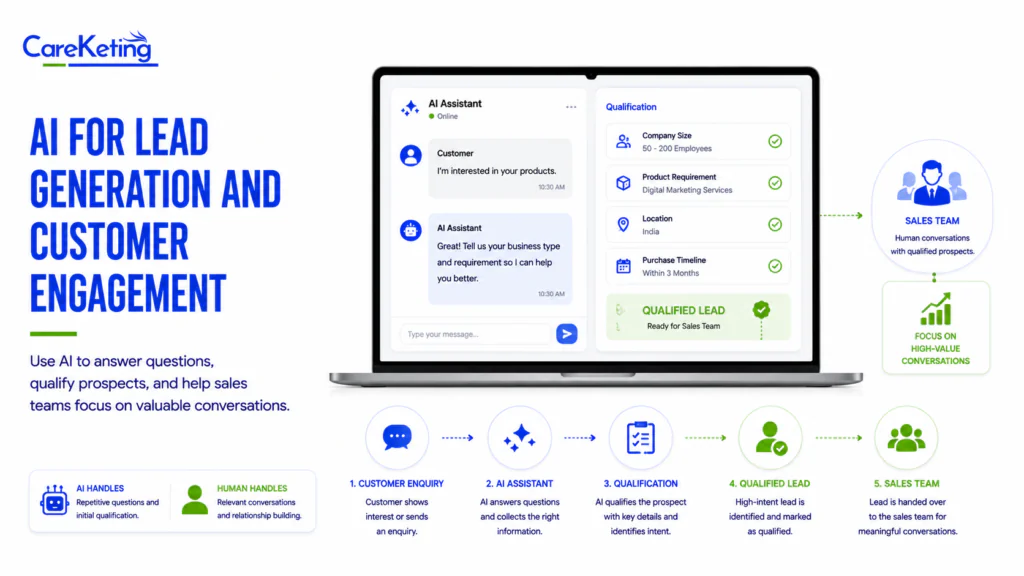
AI and digital marketing can also improve the lead generation process.
AI chatbots can answer frequently asked questions, collect basic information, qualify prospects, and direct serious enquiries to sales teams.
For a B2B company, an automated system might ask about company size, product requirement, location, and expected purchase timeline.
This can reduce repetitive work while allowing sales teams to focus on more relevant conversations.
Practical AI Marketing Examples
Example 1: Local Business
A dental clinic can use AI to analyze common customer questions and create useful content around treatments, costs, preparation, and appointment procedures.
Example 2: B2B Manufacturer
A manufacturer can use AI to categorize enquiries based on product interest, location, and business type before passing them to the sales team.
Example 3: Ecommerce Business
An ecommerce company can use predictive analytics to recommend products based on browsing and purchasing behavior.
Example 4: Marketing Agency
A marketing agency can use AI for research, reporting, content planning, campaign analysis, and creative testing while keeping strategy and final decisions under human control.
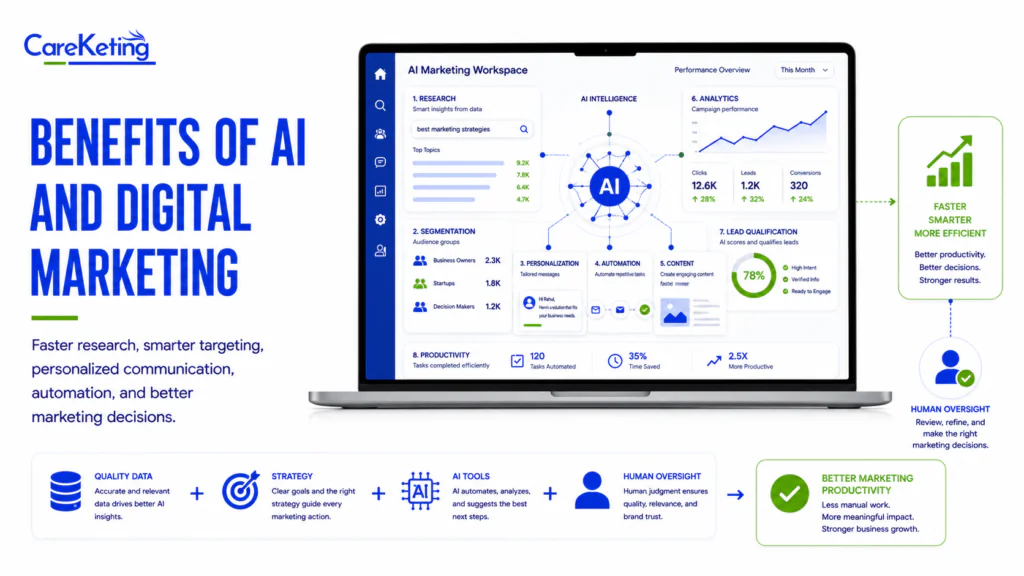
Benefits of AI and Digital Marketing
When implemented properly, AI and digital marketing can provide several practical benefits:
- Faster marketing research
- Better customer segmentation
- More personalized communication
- Automated repetitive tasks
- Faster content development
- Improved campaign analysis
- Better customer response times
- More efficient lead qualification
- Stronger data driven decision making
- Improved marketing productivity
The benefit depends on the quality of the data, strategy, tools, and human oversight.
Common Mistakes Businesses Should Avoid
The biggest mistake is assuming AI automatically creates good marketing.
AI can produce inaccurate information, repetitive content, weak messaging, or recommendations based on incomplete data.
Another mistake is using AI only to produce more content. More content does not necessarily mean more customers.
Businesses should start with a real marketing problem, then decide whether AI can solve or simplify it.
How to Use AI Effectively
A practical approach to AI and digital marketing is:
- Identify repetitive marketing tasks.
- Find areas where customer data can improve decisions.
- Use AI for research and analysis.
- Keep humans involved in strategy and quality control.
- Measure whether the technology improves actual business outcomes.
For CareKeting, the practical lesson is simple: technology should support marketing objectives, not become the objective itself. Whether the goal is lead generation, content marketing, Meta Ads, SEO, or customer engagement, the strategy should come first.
Frequently Asked Questions
What is AI and digital marketing?
AI and digital marketing means using artificial intelligence to improve activities such as content creation, customer analysis, advertising, SEO, personalization, automation, and campaign optimization.
How does AI help digital marketing?
AI can analyze customer data, automate repetitive tasks, identify patterns, support content creation, personalize communication, and assist with campaign optimization.
Can AI replace digital marketers?
AI can automate many tasks, but it does not replace strategic thinking, creativity, customer understanding, business judgment, and human accountability.
How is AI used in digital advertising?
AI can assist with audience analysis, creative variations, campaign optimization, predictive analysis, and performance evaluation.
Is AI useful for small businesses?
Yes. Small businesses can use AI for content research, customer support, lead qualification, reporting, audience analysis, and marketing automation without building complex systems themselves.
Conclusion
AI and digital marketing are becoming increasingly connected because artificial intelligence can help marketers process information faster and automate repetitive work. From SEO and content creation to advertising, customer engagement, and lead generation, there are practical applications across almost every marketing function.
But effective marketing still depends on understanding customers and making sensible decisions. The strongest approach is to combine AI capabilities with human experience, clear strategy, accurate data, and regular performance measurement.
AI should make marketing more efficient and informed. It should not make marketing less thoughtful.
If you are considering AI for your marketing, start with one repetitive task or one measurable problem. Test the solution, review the results, and expand only when it creates genuine business value.