Digital Marketing Funnel: Stages, Strategies & How to Convert More Customers
Understand how customers move from first discovering a brand to making a purchase, and learn how to improve each stage of the journey.
Introduction
Not every person who visits your website is ready to buy. Someone may have discovered your business for the first time, while another visitor may already be comparing prices and providers.
A digital marketing funnel helps businesses understand these different levels of customer intent. It maps the journey from initial awareness to consideration, purchase, and eventually repeat business.
For a small business, this distinction matters. Showing a sales offer to someone who has never heard of your company can feel premature. Similarly, giving basic educational content to someone ready to buy may waste a valuable opportunity.
A good funnel connects the right message with the right customer at the right stage.
Table of Contents
What Is a Digital Marketing Funnel?
A digital marketing funnel is a framework that describes how a potential customer moves through different stages before and after making a purchase.
The exact structure can vary by business, but a practical funnel usually includes:
- Awareness
- Consideration
- Decision
- Retention
These stages are often grouped as the top of funnel, middle of funnel, and bottom of funnel.
Consider a manufacturer that supplies industrial equipment. A potential buyer may first discover the company through Google. Later, they may read a product guide, compare specifications, request a quotation, speak with a sales representative, and eventually place an order.
Each interaction is a customer touchpoint within the broader journey.
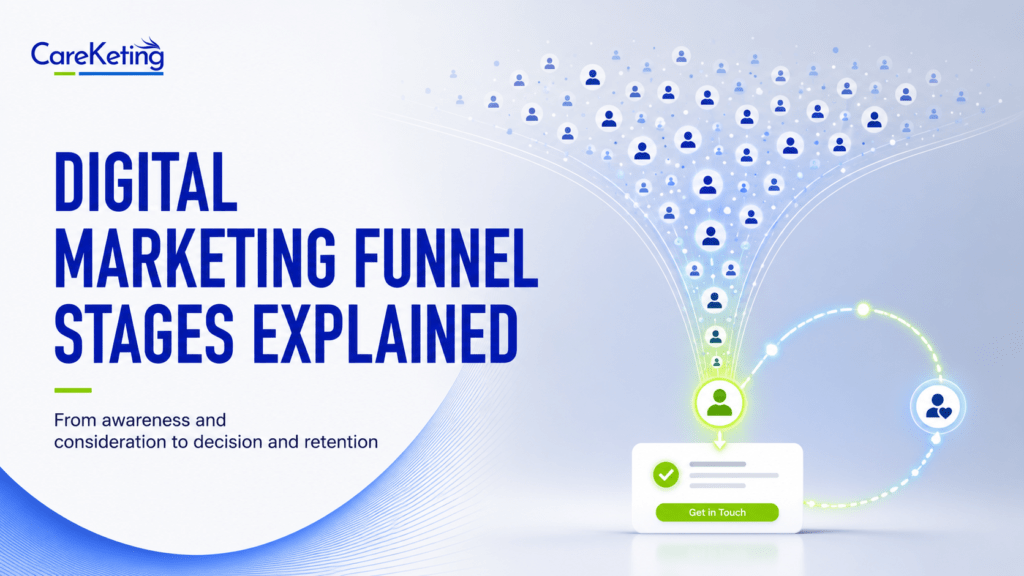
Digital Marketing Funnel Stages Explained
1. Awareness Stage
The awareness stage is where people first discover your business.
At this point, they may not know your company or even understand exactly what solution they need.
Useful channels include:
- SEO content
- Social media
- Educational videos
- Search advertising
- Informational blog posts
- Industry content
The goal is not always immediate conversion. It is to become visible when a relevant problem or need appears.
Example
A financial services company might publish educational content explaining common business financing options. Someone searching for that information may discover the company before they are ready to apply.
2. Consideration Stage
Here, the customer understands the problem and is evaluating possible solutions.
This is where businesses can provide more specific information, such as:
- Product comparisons
- Case studies
- Detailed guides
- Webinars
- Testimonials
- Product pages
- Frequently asked questions
Lead capture becomes more important at this stage.
For example, a software company might offer a detailed comparison guide in exchange for an email address. That creates an opportunity for lead nurturing.
3. Decision Stage
The prospect is now much closer to taking action.
They may be comparing suppliers, checking pricing, reviewing credibility, or speaking with sales teams.
Strong decision stage assets include:
- Free consultations
- Product demonstrations
- Quotations
- Pricing information
- Reviews
- Client case studies
- Clear calls to action
At this point, clarity matters. If someone wants to request a quotation, they should not have to search through five pages to find the form.
4. Retention Stage
The journey does not necessarily end after the purchase.
Existing customers can become repeat buyers, referrals, or long term clients.
Email communication, useful resources, customer support, loyalty programs, and relevant offers can support retention.
For many businesses, retaining a customer costs less than repeatedly finding new prospects, so the post purchase stage deserves proper attention.
Strategies to Improve a Digital Marketing Funnel
Match Content With Customer Intent
One common mistake is using the same message everywhere.
Someone searching for “what is industrial automation” needs different information from someone searching for “industrial automation supplier near me.”
Your content should reflect that difference.
Use Remarketing Carefully
Visitors who viewed a product or service page but did not convert can potentially be reached again through remarketing.
However, frequency matters. Repeatedly showing the same advertisement can become irritating rather than persuasive.
Strengthen Landing Pages
A landing page should make the next step obvious.
Check:
- Headline relevance
- Page speed
- Mobile usability
- Form length
- Trust signals
- Call to action
- Supporting information
A high traffic campaign with a weak landing page can produce disappointing results.
How to Optimize Your Digital Marketing Funnel
Measure Each Stage
Funnel analytics should show where potential customers are being lost.
For example:
10,000 visitors → 800 engaged visitors → 150 leads → 30 sales opportunities → 10 customers
This simple view can reveal where improvement is needed.
If traffic is healthy but lead volume is poor, examine the website and offer. If leads are strong but sales are weak, the problem may involve lead quality, follow up, pricing, or the sales process.
Connect Marketing and Sales Data
At CareKeting, campaign evaluation is not limited to the number of leads generated. A lead needs to be considered in the context of its quality and eventual business outcome.
A campaign producing 100 enquiries may appear better than one producing 40. But if the second campaign produces more qualified prospects and customers, the conclusion changes.
This is why conversion tracking and sales feedback should be part of funnel optimization whenever possible.
Common Digital Marketing Funnel Mistakes
Expecting Every Visitor to Buy
Most people need information and trust before making a decision.
Using Only One Funnel Stage
A business focused entirely on awareness may generate attention without enough conversions.
Ignoring Existing Customers
Customer retention and repeat purchases can be valuable parts of the funnel.
Tracking Vanity Metrics
Follower counts and impressions can be useful indicators, but they do not always represent business success.
Making the Funnel Too Complicated
A funnel should help decision making, not create unnecessary complexity. Start with the actual customer journey and build from there.
Frequently Asked Questions
What is a digital marketing funnel?
A digital marketing funnel is a framework used to understand how people move from discovering a business to considering its offering, becoming customers, and potentially returning for future purchases.
What are the main stages of a digital marketing funnel?
The common stages are awareness, consideration, decision, and retention. Some businesses use additional stages depending on their customer journey.
Why is a digital marketing funnel important?
It helps businesses understand customer intent and create suitable content, advertising, offers, and follow up for different stages of the buying process.
How can I generate leads through a digital marketing funnel?
Businesses can combine SEO, content marketing, social media, paid advertising, landing pages, lead forms, email marketing, and remarketing to attract and nurture potential customers.
How do I measure funnel performance?
Track metrics such as traffic, engagement, leads, conversion rate, cost per lead, qualified opportunities, customer acquisition cost, sales, and revenue.
Conclusion
A digital marketing funnel is not simply a diagram with boxes labelled awareness, consideration, and conversion. It is a practical way to understand how real customers make decisions.
The strongest funnels connect customer intent, useful content, appropriate marketing channels, lead nurturing, sales follow up, and measurable outcomes.
Instead of asking only how much traffic or how many leads a campaign generated, businesses should ask a more useful question: What happened to those people after they entered the funnel?
That perspective leads to better marketing decisions and more meaningful improvements in conversion.
Review your current customer journey from first interaction to purchase. Identify the stage where the most prospects are being lost, then focus your next marketing improvement there.