
Digital Marketing Leads: How to Generate, Capture & Convert Quality Leads
A practical guide to generating digital marketing leads through SEO, content, social media, paid advertising, lead capture, and effective follow up.
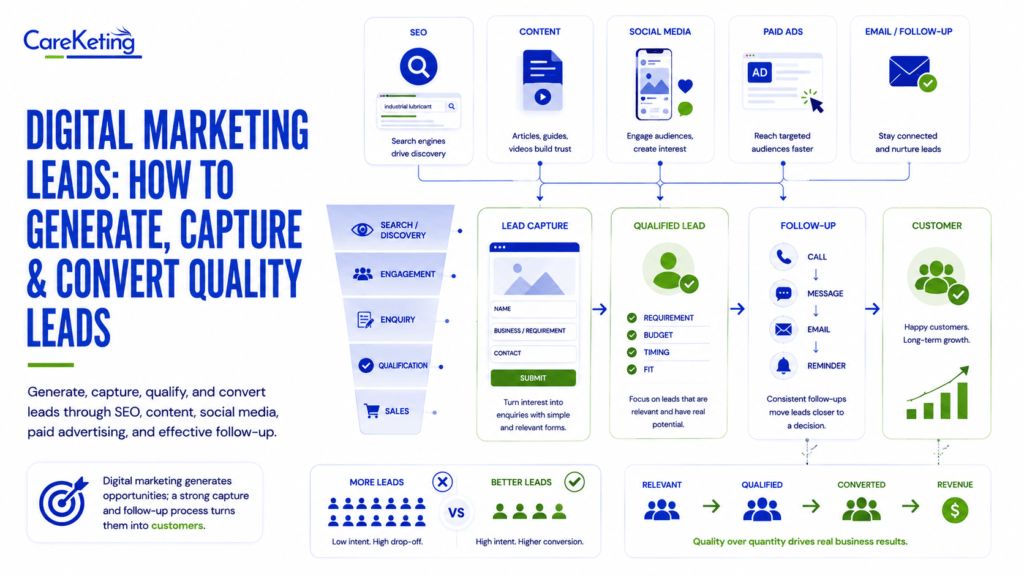
Introduction
Getting traffic to a website or views on an advertisement is useful, but it does not automatically create business. What matters is whether the right people take the next step.
That is where digital marketing leads become important.
A lead is a person or business that has shown some level of interest in what you offer. They might submit a form, request a quotation, call your business, send a message, or sign up for more information.
For a manufacturer, a lead could be a distributor asking about dealership opportunities. For a local service business, it could be someone requesting a quotation. The definition changes slightly by business, but the principle remains the same: attention must eventually become a meaningful business conversation.
Table of Contents
What Are Digital Marketing Leads?
Digital marketing leads are potential customers who have interacted with a business through a digital channel and shown enough interest to take an identifiable action.
This action might include:
- Filling out a website form
- Calling the business
- Sending a WhatsApp message
- Downloading a resource
- Requesting a quotation
- Registering for an event
- Starting a purchase process
Not every lead is equally valuable.
A person who submits a form without genuine interest is very different from a potential customer who matches your target market, has a relevant requirement, and is ready to discuss pricing.
This is why businesses should focus on qualified leads, not simply lead volume.
How Lead Generation in Digital Marketing Works
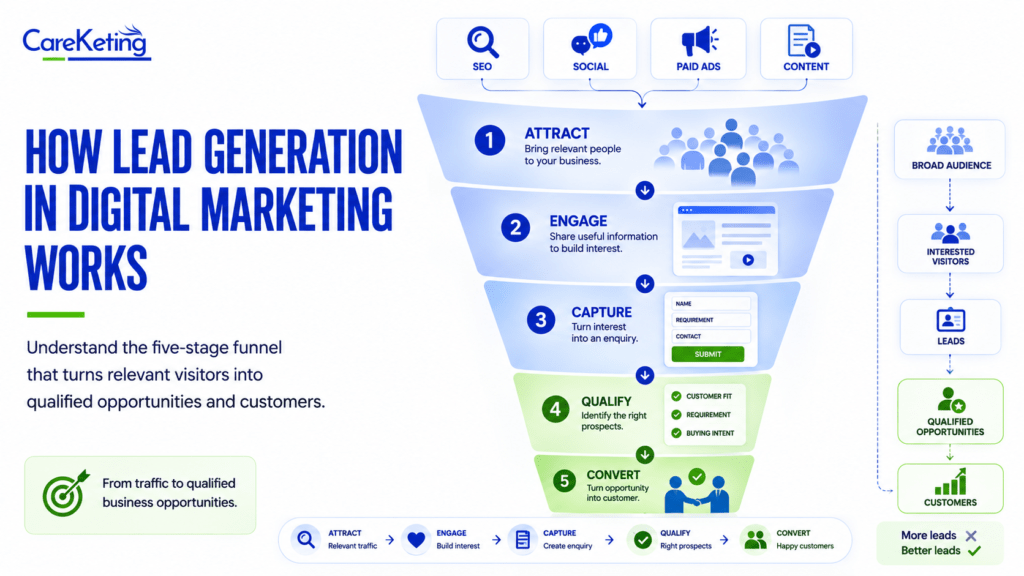
A basic lead generation in digital marketing process usually has five stages:
Attract: Bring relevant people to your business through search, social media, advertising, or content.
Engage: Give them useful information that addresses their needs.
Capture: Provide a clear way to make contact.
Qualify: Determine whether the enquiry matches your customer profile.
Convert: Move the opportunity toward a sale.
This process is often called a marketing funnel or conversion funnel.
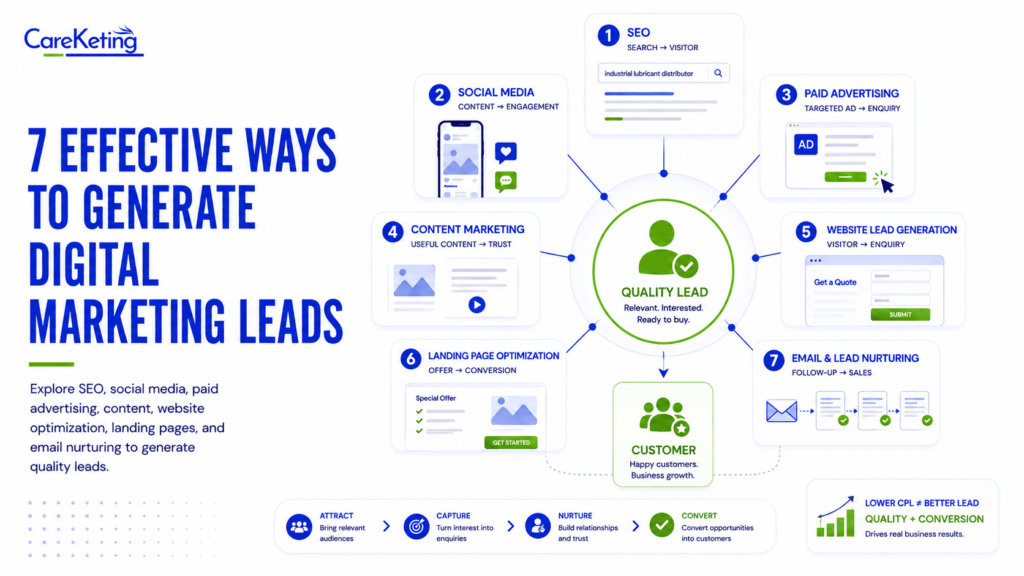
7 Effective Ways to Generate Digital Marketing Leads
1. SEO Lead Generation
SEO can attract people searching for products, services, problems, and solutions related to your business.
For example, a manufacturer could create useful pages answering questions buyers commonly search before requesting a quotation.
The advantage is that relevant content can continue attracting organic traffic over time.
2. Social Media Lead Generation
Social platforms can help businesses generate leads through organic content, direct messages, lead forms, and paid campaigns.
A local business might use location focused advertising, while a B2B company could publish educational content aimed at decision makers.
3. Paid Advertising
Online advertising can generate leads quickly when targeting, messaging, offer, and landing page are aligned.
Google Ads can capture existing search intent, while social advertising can help businesses reach selected audience groups.
However, cheaper leads are not necessarily better leads. Lead quality must be considered alongside cost per lead.
4. Content Marketing
Useful content can attract potential customers before they are ready to contact a sales team.
Guides, case studies, product comparisons, tutorials, videos, and frequently asked questions can help establish expertise while moving prospects toward an enquiry.
5. Website Lead Generation
Your website should make it easy for interested visitors to take the next step.
Depending on the business, this could mean a quotation form, consultation request, phone number, WhatsApp option, booking system, or product enquiry form.
6. Landing Page Optimization
A landing page should match the advertisement or search query that brought the visitor there.
If an advertisement promotes a specific service, sending the user to a generic homepage can create unnecessary friction.
Keep the message clear, explain the offer, provide evidence where appropriate, and make the desired action obvious.
7. Email Marketing and Lead Nurturing
Not every prospect is ready to buy immediately.
Email can help businesses continue communication with people who have already shown interest.
Educational emails, useful resources, product information, and relevant follow ups can keep a business connected until the prospect is ready to make a decision.
How to Capture and Qualify Digital Marketing Leads
Generating digital marketing leads is only half the job.
A business should decide what information it needs to determine whether a lead is relevant.
For a B2B manufacturer, useful information might include business type, location, current purchase volume, requirement, budget range, and expected purchase timeline.
A simple CRM for lead management can then organize enquiries and track follow up.
Businesses with more structured sales processes may also classify prospects as marketing qualified leads and sales qualified leads based on predefined criteria.
Lead Nurturing and Conversion
A lead should not disappear simply because they did not purchase on the first conversation.
Good follow up depends on the reason the prospect did not convert.
Perhaps they need more information. Maybe the timing is wrong. They may be comparing suppliers or waiting for approval.
A practical lead nurturing process can include scheduled calls, emails, product information, educational content, reminders, and relevant offers.
The objective is not to repeatedly pressure the prospect. It is to remain useful and available while the buying decision develops.
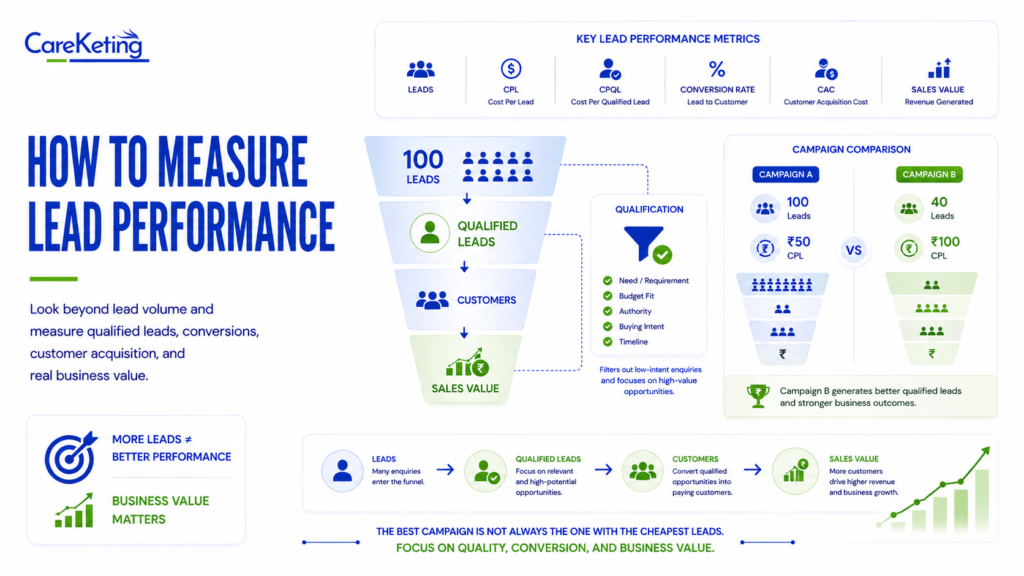
How to Measure Leads Performance
Businesses should track more than the number of enquiries.
Important metrics can include:
- Number of leads
- Qualified lead rate
- Cost per lead
- Cost per qualified lead
- Conversion rate
- Lead to customer rate
- Sales value
- Customer acquisition cost
For example, Campaign A may generate 100 leads at ₹50 each, while Campaign B generates 40 leads at ₹100 each.
If Campaign B produces significantly more customers, it may actually be the stronger campaign.
That is why digital marketing leads should ultimately be evaluated by business value, not just volume.
Common Mistakes
One common mistake is optimizing campaigns only for cheap leads.
Another is using a complicated form that discourages genuinely interested prospects.
Poor follow up is another major issue. A good lead can lose value simply because nobody responds quickly or consistently.
Businesses should also avoid sending every lead directly to the sales team without basic qualification.
Frequently Asked Questions
What are digital marketing leads?
Digital marketing leads are potential customers who show interest through a digital channel and take an identifiable action such as submitting a form, calling, messaging, or requesting information.
How can I generate digital marketing leads?
Businesses can use SEO, content marketing, social media, paid advertising, email marketing, landing pages, websites, and other online lead generation methods.
What is a qualified lead?
A qualified lead matches important criteria such as customer type, requirement, location, budget, purchasing ability, or buying timeline.
How can I improve lead quality?
Improve audience targeting, make your offer specific, use qualifying questions, create relevant landing pages, and regularly review which sources produce actual customers.
What is cost per lead?
Cost per lead is the amount spent to generate a lead. It is calculated by dividing campaign spending by the number of leads generated.
Are cheap digital marketing leads always better?
No. A low cost lead is useful only if the person or business is genuinely relevant. Lead quality and eventual conversion should be considered alongside acquisition cost.
Conclusion
Generating digital marketing leads is not simply about getting more people to fill out a form. The real objective is to attract the right audience, provide a useful reason to make contact, capture relevant information, qualify the opportunity, and follow up properly.
SEO, content marketing, social media, paid advertising, email, and website optimization can all contribute to the process. But the strongest results usually come when these channels work as part of one connected system.
For any business, the most useful question is not “How many leads did we generate?” It is “How many relevant business opportunities did those leads create?”
Start by defining what a good lead looks like for your business. Once that definition is clear, you can build your targeting, campaigns, forms, follow up process, and reporting around attracting more of those prospects.