Digital Marketing & SEO: How They Work Together to Grow Your Business
A practical guide to understanding SEO in digital marketing, how search engine optimization supports online growth, and how businesses can combine organic and paid marketing effectively.
Introduction
Many businesses treat digital marketing and SEO as two separate activities. In practice, they work much better when planned together.
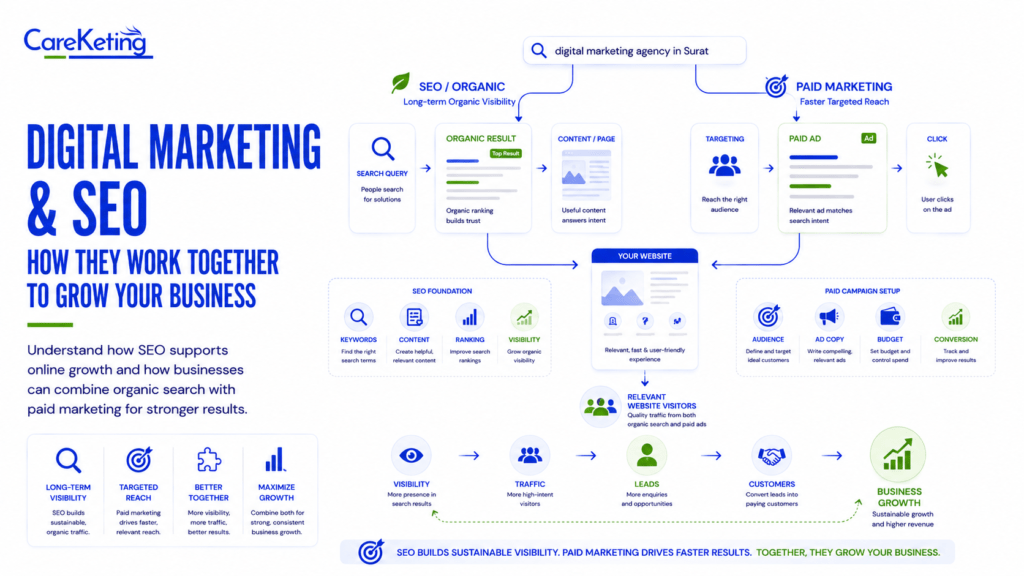
Digital marketing & SEO have different roles, but they often support the same business goal. Digital marketing can include social media, paid advertising, email, content, websites, and other online channels. SEO focuses specifically on helping relevant web pages appear in organic search results.
For example, a manufacturer may use Google Ads to generate enquiries immediately while building SEO content around product related searches for long term organic traffic. One channel provides paid visibility, while the other works toward sustainable search visibility.
Understanding this relationship helps businesses make better marketing decisions instead of treating every channel as an isolated activity.
Table of Contents
What Is Digital Marketing & SEO?
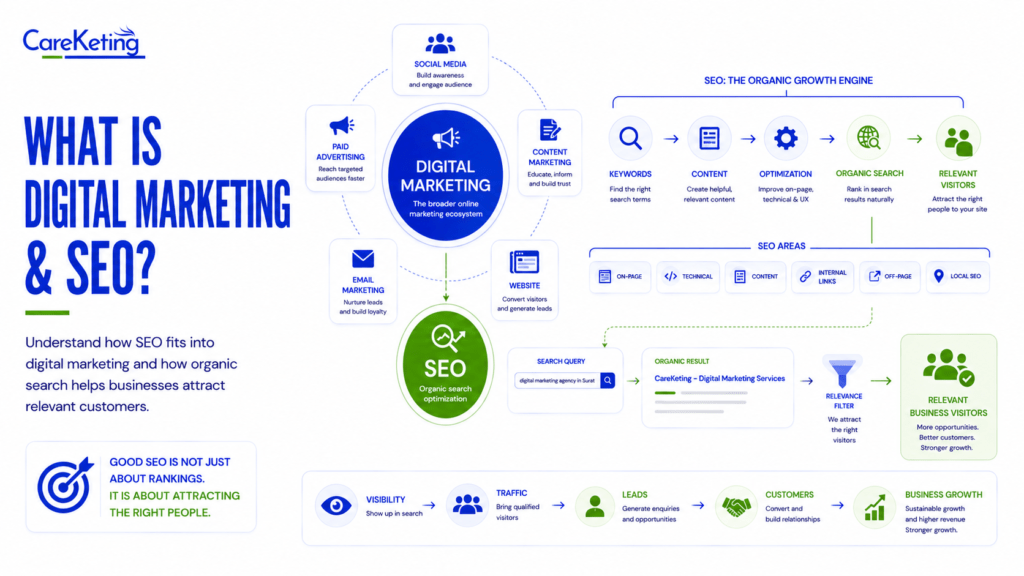
Digital marketing & SEO can be understood as two connected parts of online marketing.
Digital marketing is the broader practice of promoting a business through digital channels. SEO, or search engine optimization, is one part of that broader system.
SEO focuses on improving a website so search engines can understand its content and users can find useful information through organic search.
The main areas include:
- Keyword research
- On page SEO
- Technical SEO
- Content optimization
- Internal linking
- Off page SEO
- Link building
- Local SEO
- Search performance measurement
The objective is not simply to rank for more keywords. Good SEO should attract people who are genuinely relevant to the business.
How SEO Fits Into Digital Marketing
SEO is often considered an organic digital marketing channel because businesses do not pay a search engine every time someone clicks an organic result.
Suppose a company sells industrial cleaning equipment. It could create useful pages targeting searches such as equipment specifications, maintenance questions, buying guides, and product applications.
Over time, those pages may attract organic website traffic from people researching the products.
This is where SEO in digital marketing becomes valuable. Search behaviour can reveal what potential customers are actively looking for, which can then influence content, advertising, landing pages, and sales messaging.
SEO Supports Long Term Search Visibility
Paid advertising can provide immediate visibility while the campaign is active. Organic search can take longer to develop, but successful pages may continue attracting visitors after publication.
That does not mean SEO is free or effortless. Research, content development, technical work, optimization, monitoring, and updates all require resources.
The advantage is that SEO can become a valuable long term acquisition channel when it is built around genuine customer needs.
How Digital Marketing Supports SEO
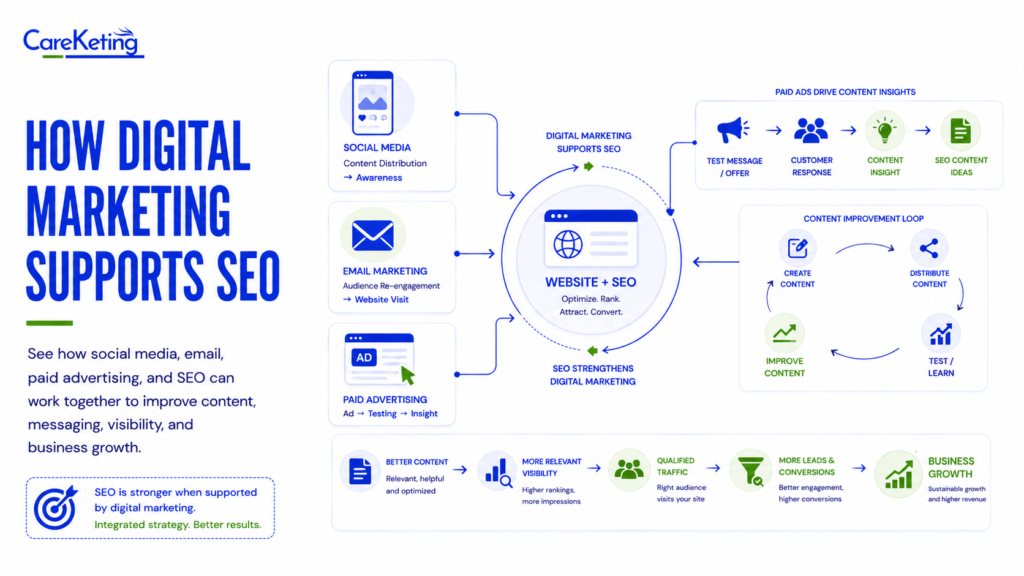
The relationship works in both directions.
Social media can help distribute useful content and increase awareness of a brand. Email can bring existing audiences back to useful website resources. Paid advertising can help test messaging and landing pages before businesses invest heavily in organic content.
For example, if an advertising campaign shows that customers respond strongly to a particular product benefit, that insight could influence future website content and SEO pages.
This is one reason an integrated digital marketing SEO strategy can be more useful than treating SEO as a completely separate project.
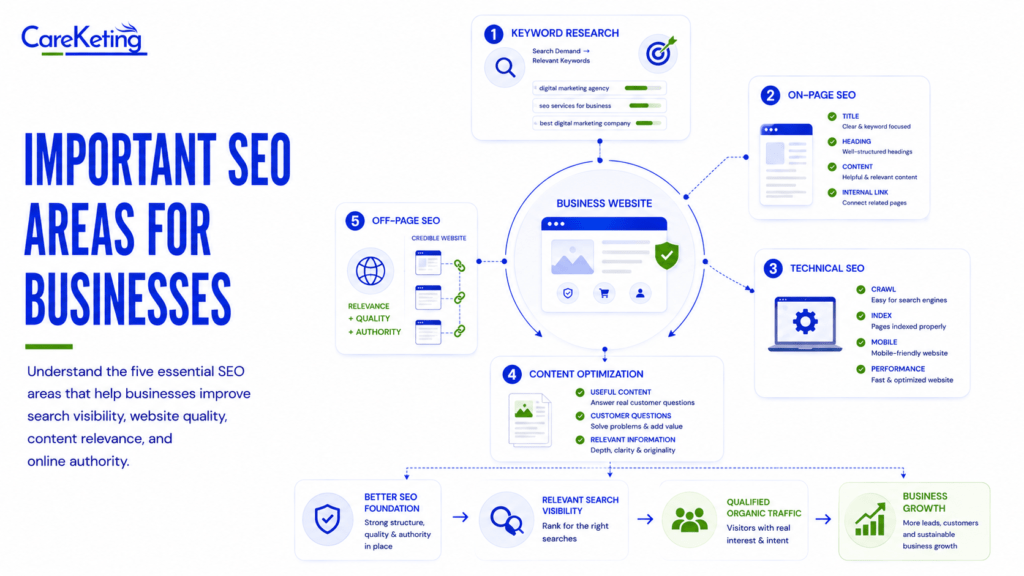
Important SEO Areas for Businesses
1. Keyword Research
Keyword research helps identify what people search for and how those searches relate to the business.
The best keywords are not always those with the highest search volume. A smaller keyword with strong buying intent may be more valuable to a B2B company.
2. On Page SEO
On page SEO includes elements such as page titles, headings, content structure, internal links, images, and relevant information.
The page should make sense to the reader first.
3. Technical SEO
Technical SEO focuses on the website’s ability to be crawled, understood, and accessed efficiently.
Issues involving indexing, page performance, mobile usability, structured data, redirects, and site architecture can affect search performance.
4. Content Optimization
Useful content should answer the questions people actually have.
A manufacturer, for instance, can create detailed product guides instead of publishing hundreds of thin pages that provide little practical information.
5. Off Page SEO
Off page SEO includes activities that build a website’s authority and reputation outside its own pages.
Relevant and genuine links from credible websites can contribute to a site’s overall authority. However, link building should focus on quality and relevance rather than simply collecting large numbers of links.
A Practical Digital Marketing & SEO Example
Imagine a local accounting firm wants more business enquiries.
Its digital marketing strategy could include Google Ads for immediate visibility, social media content for brand awareness, email communication for existing contacts, and SEO content targeting questions that potential clients search before contacting an accountant.
The SEO strategy could focus on service pages, local search visibility, useful guides, and frequently asked questions.
Performance could then be evaluated through relevant metrics such as organic traffic, search impressions, enquiries, qualified leads, and conversions.
This approach connects SEO with an actual business objective rather than treating search rankings as the final goal.
Common Mistakes
One common mistake is expecting SEO results immediately.
Another is creating content solely because a keyword has search volume. If the page does not satisfy the user’s actual question, ranking alone will not create a strong customer experience.
Businesses also sometimes ignore technical SEO while continuously publishing new articles.
Finally, SEO should not be viewed as a replacement for every other marketing channel. Paid advertising, social media, email, content, and SEO can complement each other when each has a defined role.
Frequently Asked Questions
Is SEO part of digital marketing?
Yes. SEO is generally considered one of the major digital marketing channels. It focuses on improving organic visibility in search engines.
Why is SEO important in digital marketing?
SEO can help businesses attract relevant organic search traffic, improve visibility, answer customer questions, and create long term opportunities for website visits and conversions.
What is the difference between SEO and digital marketing?
Digital marketing is the broader field covering multiple online marketing channels. SEO is one specific discipline focused on organic search visibility.
How long does SEO take to show results?
There is no universal timeline. Results depend on competition, website condition, content quality, authority, search demand, and the work being performed. SEO usually requires consistent effort over time.
Can SEO generate leads?
Yes. SEO can generate leads when pages attract relevant users and provide a clear path toward an enquiry, consultation, purchase, or other business action.
Should a business use SEO and paid advertising together?
They can work well together. Paid advertising can provide immediate visibility and testing opportunities, while SEO can build organic search visibility over the longer term.
Conclusion
Digital marketing & SEO work best when businesses understand the different roles each channel plays.
SEO can build organic search visibility, while paid advertising can provide faster reach. Social media can support awareness and engagement, while email can help maintain relationships with existing audiences.
The strongest strategy is rarely about choosing one channel and ignoring everything else. It is about understanding the customer journey and using each marketing activity where it can contribute the most value.
For businesses investing in SEO, the goal should not simply be higher rankings. The more useful question is whether search visibility is bringing the right people to the website and moving them closer to becoming customers.
Start by identifying three questions your potential customers regularly search for. Build genuinely useful pages around those questions, then connect those pages with your wider content, advertising, and customer acquisition strategy.