
Lead Generation Tools: 7 Best Tools to Capture, Manage & Convert Leads
A practical guide to choosing lead generation tools for capturing enquiries, managing prospects, automating follow ups, and improving conversions.
Introduction
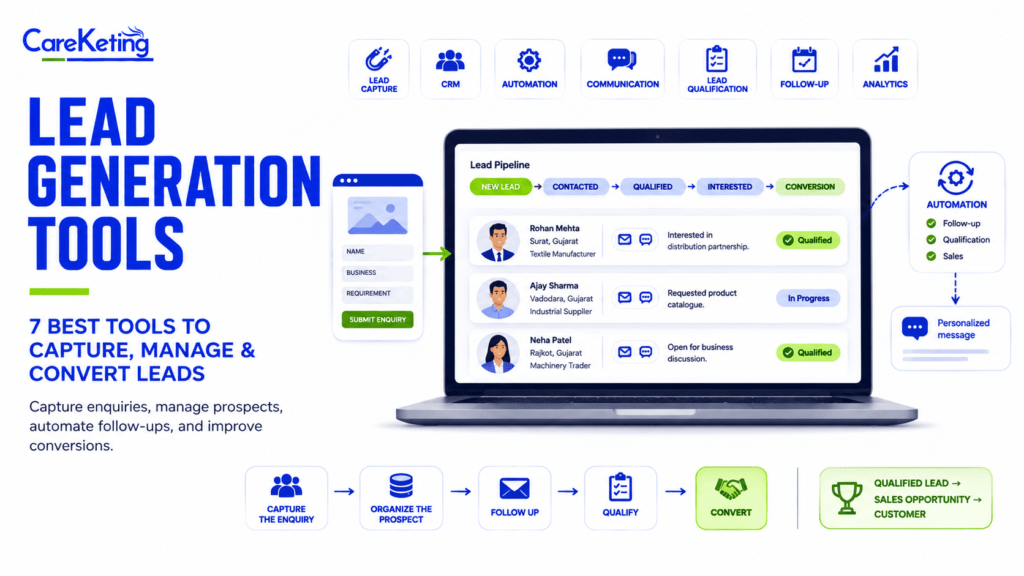
Getting enquiries is only the first part of lead generation. The real challenge starts when a business has to store those enquiries, respond quickly, identify serious prospects, and follow up without losing track of anyone.
This is where lead generation tools become useful. They can help businesses capture leads through forms and landing pages, organize customer information, automate follow ups, track conversations, and understand which campaigns are actually producing results.
For example, a manufacturer may receive enquiries from Facebook, Google, WhatsApp, and its website. Without a proper system, those enquiries can easily become scattered across spreadsheets, inboxes, and personal phones.
The right lead generation tools bring these activities into a more organized process.
Table of Contents
What Are Lead Generation Tools?
Lead generation tools are software applications or platforms that help businesses attract, capture, organize, qualify, nurture, and track potential customers.
Some tools focus on one specific task. Others combine several functions.
For example, a form builder can collect contact details, while CRM software can store those details and track the prospect through the sales process.
The important point is that you do not necessarily need seven different subscriptions. A small business may only need two or three well connected tools.
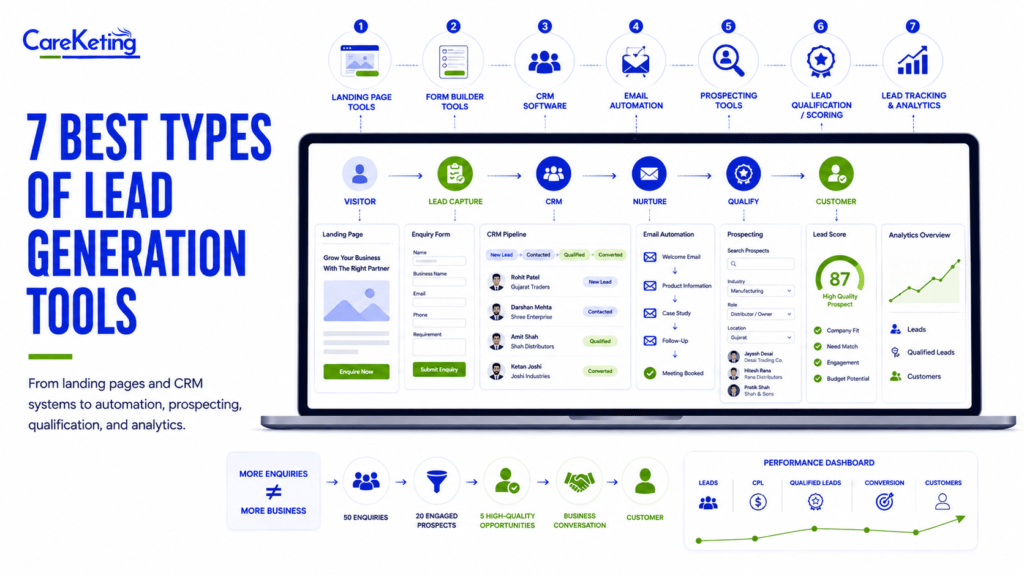
7 Best Types of Lead Generation Tools
1. Landing Page Tools
Landing page tools help businesses create dedicated pages for specific campaigns.
Instead of sending an advertisement to a general homepage, you can send visitors to a page focused on one offer.
A B2B machinery company, for instance, could create a page offering a product catalogue. Visitors enter their business details to receive the catalogue, creating a potential sales opportunity.
Best for: Paid advertising, product enquiries, consultations, and B2B campaigns.
2. Form Builder Tools
Form builder tools make lead capture easier.
A good form should collect enough information to qualify a prospect without making the process unnecessarily difficult.
For a distributor campaign, useful questions might include business type, current monthly sales, location, investment capacity, and expected starting date.
These details can be more valuable than simply collecting a name and phone number.
3. CRM Software
CRM software is one of the most important lead management tools for growing businesses.
A CRM can store contact information, record interactions, assign leads to salespeople, and show where each prospect stands.
A simple pipeline might include:
New Lead → Contacted → Interested → Qualified → Converted → Lost
This gives the sales team a clear view of what needs attention.
4. Email Marketing Automation Tools
Not every prospect is ready to buy immediately.
Email automation can help businesses maintain communication with prospects through useful information, product updates, case studies, reminders, or offers.
For example, a software company could send a short educational email after someone downloads its product guide, followed by an invitation for a product demonstration.
This is where lead nurturing software becomes valuable.
5. Prospecting Tools
Prospecting tools are particularly useful for B2B companies looking for potential business customers.
They can help sales teams identify companies, decision makers, professional contact information, and other relevant business data.
However, data quality matters. A large database is not automatically a good database.
Always verify whether contacts are relevant to your ideal customer profile before starting outreach.
6. Lead Qualification and Lead Scoring Tools
Not every enquiry deserves the same level of sales attention.
Lead scoring software can assign values based on factors such as company size, location, enquiry type, website activity, budget, or buying intent.
Suppose a manufacturer receives 50 enquiries. Five are from established distributors actively looking for suppliers, while the rest are casual product enquiries.
A qualification system can help the sales team prioritize the five stronger opportunities.
7. Lead Tracking and Analytics Tools
Lead generation analytics help answer a question that businesses often overlook:
Which marketing activity is actually producing customers?
You can track metrics such as:
- Number of leads
- Cost per lead
- Qualified lead rate
- Conversion rate
- Source of leads
- Sales generated
- Customer acquisition cost
For example, Facebook may produce 100 enquiries at a low cost, while Google produces 30 enquiries at a higher cost. If Google generates more paying customers, its actual business value may be higher.
How to Choose the Right Lead Generation Tools
The right choice depends on your business model, sales process, team size, and budget.
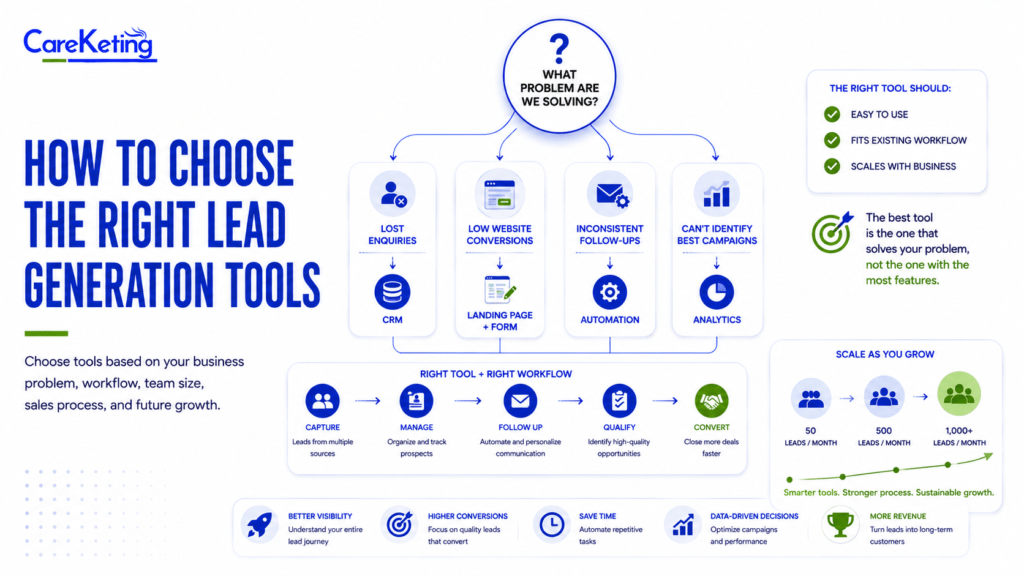
Before buying any lead generation software, ask:
What problem are we trying to solve?
If enquiries are getting lost, start with CRM lead management.
If website visitors are not converting, consider landing page and form tools.
If follow ups are inconsistent, look at marketing automation.
If the business cannot identify its best campaigns, improve lead tracking and analytics.
Does it fit our existing workflow?
A tool should make work simpler, not create another complicated process for your team.
Can it grow with the business?
A very cheap tool may work for 50 leads a month but become difficult to manage at 1,000 leads.
Common Mistakes When Using Lead Generation Tools
The biggest mistake is assuming software will fix a weak marketing process.
A CRM cannot compensate for poor targeting. Automation cannot fix an unclear offer. A sophisticated form cannot make an unsuitable audience interested.
Another common problem is collecting too much information. Businesses sometimes create long forms because they want detailed customer data. In practice, excessive questions can reduce conversions.
Start with the information your sales team genuinely needs.
Frequently Asked Questions
What are lead generation tools?
Lead generation tools are software platforms that help businesses capture, organize, qualify, nurture, and track potential customers.
Which lead generation tool is best for small businesses?
A small business will often benefit most from a simple CRM combined with a form or landing page tool. The right choice depends on how leads currently enter the business.
Are free lead generation tools available?
Yes. Some platforms offer free plans or basic free lead capture tools. They can be useful when starting, although advanced automation and reporting may require paid features.
What is the difference between lead generation and lead management tools?
Lead generation tools help capture new prospects. Lead management tools help organize, qualify, follow up with, and track those prospects after they enter the sales process.
Can lead generation tools automate follow ups?
Yes. Many platforms can automate emails, reminders, notifications, lead assignments, and other parts of the follow up process.
Do B2B companies need lead generation tools?
They can be particularly useful for B2B businesses because B2B sales often involve longer decision cycles, multiple contacts, qualification stages, and repeated follow ups.
Conclusion
The best lead generation tools are not necessarily the tools with the longest feature list. They are the ones that solve a real problem in your sales and marketing process.
A small business may begin with a form and CRM. As the number of enquiries grows, it can add automation, lead scoring, analytics, and other capabilities.
The goal should always be the same: capture the right prospects, respond to them properly, and make it easier for your sales team to turn genuine opportunities into customers.
Before choosing a new tool, map your current lead process from first enquiry to final sale. The gaps in that process will usually tell you which type of tool you actually need.