
Lead Generation: Meaning, Process, Types, Strategies & Examples
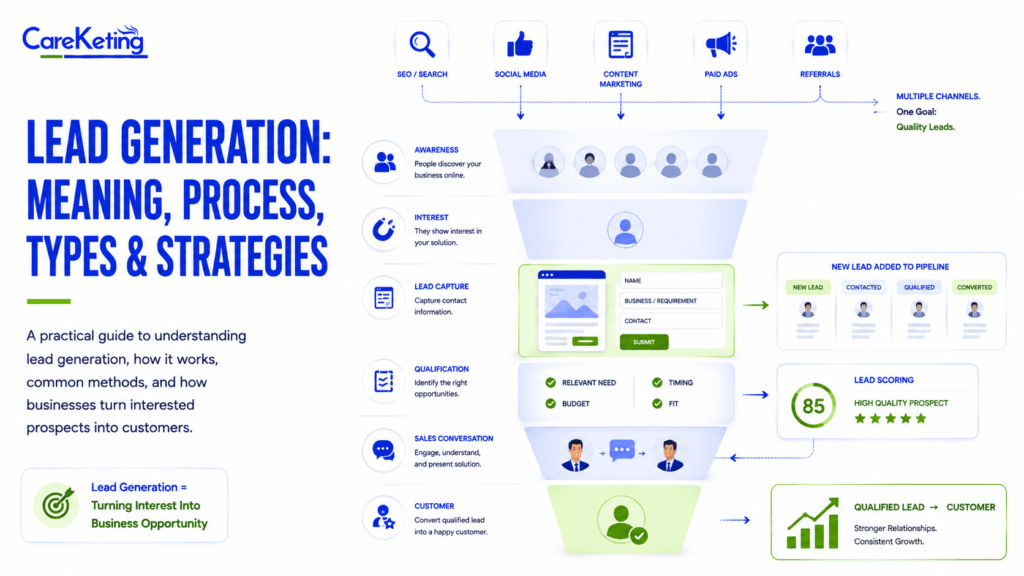
A practical guide to understanding lead generation, how it works, common methods, and how businesses can turn interested prospects into customers.
Introduction
A business can have a great product, an attractive website, and a strong social media presence, but growth becomes difficult if potential customers are not entering the sales process. This is where lead generation becomes important.
So, what is lead generation? In simple terms, it is the process of attracting people who may be interested in your product or service and encouraging them to take a meaningful action. That action could be filling out a form, making a call, sending a message, requesting a quotation, or booking a consultation.
For a manufacturer, a lead could be a distributor looking for a new supplier. For a dentist, it could be someone requesting an appointment. The approach changes by industry, but the basic principle stays the same.
Table of Contents
What Is Lead Generation?
The lead generation definition is straightforward: it is the process of identifying and attracting prospective customers and collecting their information or encouraging them to begin a business conversation.
A person who sees your Instagram post is not necessarily a lead. Someone who clicks the advertisement and submits an enquiry form has shown a much stronger buying signal.
The main objective is therefore not simply to reach more people. It is to attract the target audience and create opportunities for customer acquisition.
How the Lead Generation Process Works
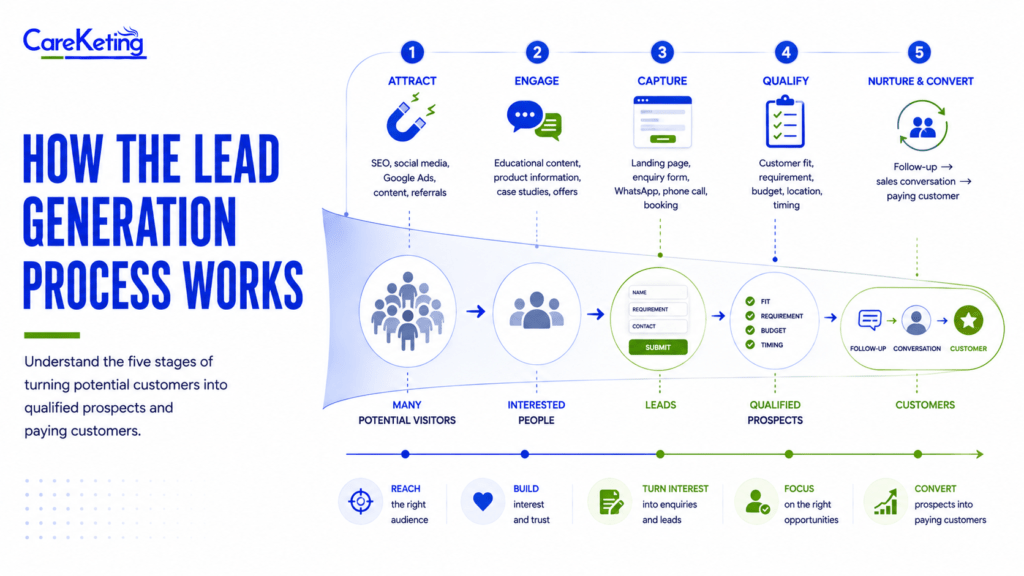
A typical lead generation process has five stages.
1. Attract
First, businesses need to reach people who could potentially become customers. SEO, social media, Google Ads, content marketing, referrals, and other channels can help.
2. Engage
Once people discover the business, useful content, product information, case studies, offers, or educational resources can build interest.
3. Capture
The next step is lead capture. This may happen through a landing page, contact form, WhatsApp conversation, phone call, booking form, or enquiry page.
4. Qualify
Not every enquiry is valuable. Businesses should identify whether the person fits their ideal customer profile.
For example, a B2B company selling industrial machinery may ask about business type, location, production requirements, budget, and expected purchase timeline.
5. Nurture and Convert
Some prospects are ready to buy immediately. Others need more time.
Lead nurturing keeps relevant prospects engaged until they are ready for a sales conversation. The final objective is lead conversion, where a prospect becomes a paying customer.
Types of Leads
Understanding different types of leads helps sales teams prioritize their efforts.
Marketing Leads
These are prospects who have interacted with marketing activities and shown interest.
Sales Leads
These prospects have demonstrated a stronger buying intention and may be ready for direct sales communication.
Qualified Leads
A qualified lead matches specific criteria established by the business.
For example, a business loan company may consider annual turnover, business age, location, and financial eligibility before sending an enquiry to its sales team.
Lead Generation Methods and Channels
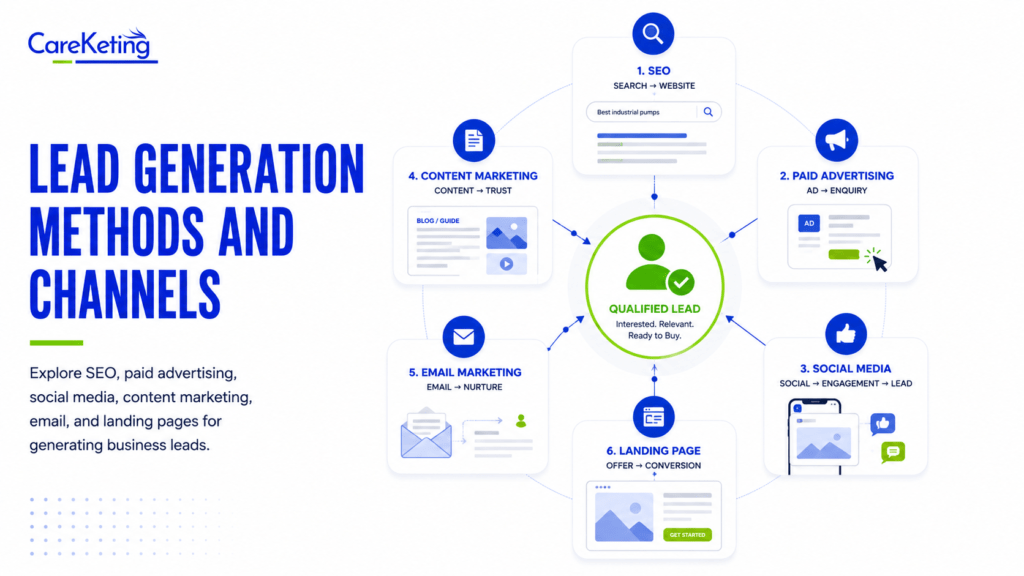
There is no single channel that works for every business. Some of the most common lead generation methods include:
SEO
Search engine optimization can attract people who are actively looking for relevant products or services.
Paid Advertising
Google Ads and social media advertising can produce enquiries by placing offers in front of specific audiences.
Social Media
Organic posts, direct messages, lead forms, videos, and social media campaigns can support both awareness and lead generation.
Content Marketing
Guides, articles, videos, case studies, and product education can attract prospects and build trust before a sales conversation.
Email Marketing
Email can help businesses nurture existing prospects and encourage them to take the next step.
Landing Pages
A focused landing page can convert advertising traffic by presenting one clear offer and one primary action.
7 Practical Lead Generation Strategies
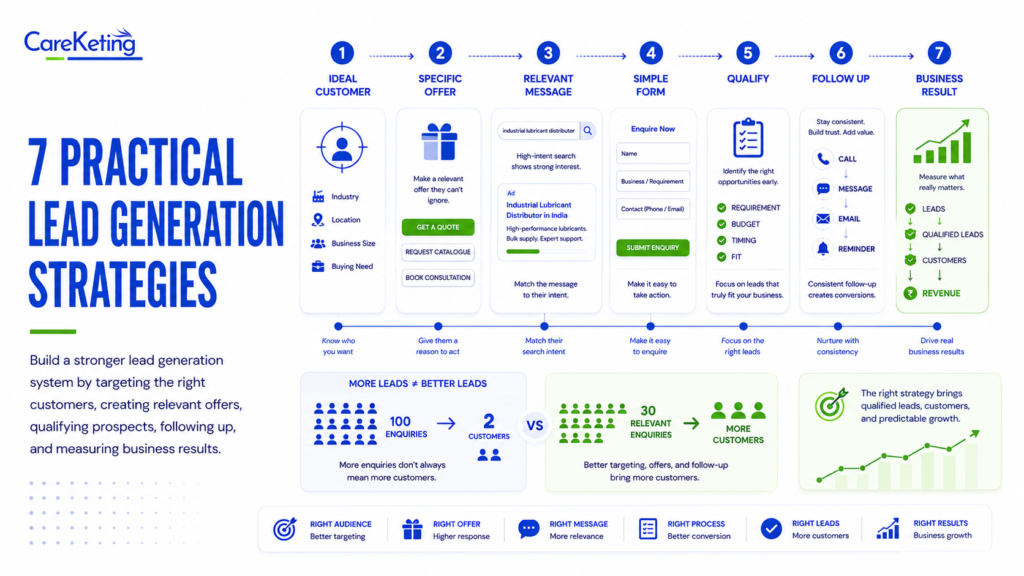
1. Define Your Ideal Customer
Before spending money on advertising, identify who you actually want as a customer.
Consider location, industry, business size, buying ability, common problems, and purchasing behaviour.
2. Create a Specific Offer
“Contact us today” is often weaker than a useful reason to make contact.
A quotation, consultation, product catalogue, sample request, or eligibility check can give prospects a clearer reason to respond.
3. Match Your Message to Search Intent
Someone searching for “industrial lubricant distributor” has a different intent from someone searching for “what is engine oil.”
Your content and advertisements should reflect that difference.
4. Keep Forms Simple
Ask only for information that you genuinely need. A long form can discourage people who are interested but not yet ready to spend several minutes entering details.
5. Qualify Leads Early
Use relevant questions to separate genuine prospects from low quality enquiries.
6. Follow Up Consistently
A good lead can become useless if nobody responds. Establish a clear process for calls, messages, emails, and reminders.
7. Measure Business Results
Track more than the number of enquiries.
Useful metrics include:
- Lead volume
- Cost per lead
- Qualified lead rate
- Conversion rate
- Customer acquisition cost
- Sales generated
- Revenue from leads
A campaign generating 100 enquiries may look impressive, but if only two become customers, the result may be weaker than a campaign producing 30 highly relevant enquiries.
Lead Generation Examples
Consider a Surat based textile machinery supplier. Instead of simply running an advertisement saying “Best Machinery Available,” the company could offer a machinery consultation or product catalogue.
A visitor clicks the advertisement, reaches a dedicated landing page, submits business details, and receives a follow up from the sales team.
That is a complete lead generation campaign.
Similarly, a local dental clinic could use Google search advertising to reach people searching for dental treatment, direct them to an appointment page, and follow up with enquiries.
The best strategy depends on the buying process, customer value, competition, and sales cycle.
Common Lead Generation Mistakes
Several problems repeatedly reduce lead quality.
Targeting everyone: Broad targeting often creates volume without relevance.
Focusing only on cheap leads: A low cost lead is not automatically a valuable lead.
Poor follow up: Slow responses can result in prospects choosing another provider.
Weak landing pages: Confusing messages and unclear calls to action can waste advertising traffic.
Ignoring sales data: Marketing should learn which leads eventually become customers.
Frequently Asked Questions
What is lead generation in simple words?
Lead generation means finding potential customers and encouraging them to show interest in your product or service.
What are the main lead generation methods?
Common methods include SEO, paid advertising, social media marketing, content marketing, email marketing, referrals, landing pages, and direct outreach.
What is a qualified lead?
A qualified lead is a prospect who meets the criteria that make them a realistic potential customer for the business.
How can businesses generate leads online?
Businesses can use search engines, social media, websites, landing pages, online advertising, content, email, and other digital channels to attract and capture prospects.
What is the difference between lead generation and lead conversion?
Lead generation creates potential customer opportunities. Lead conversion turns those opportunities into actual customers.
Why is lead nurturing important?
Many prospects are not ready to purchase immediately. Lead nurturing keeps communication relevant and helps move interested prospects closer to a buying decision.
Conclusion
Lead generation is more than collecting names and phone numbers. It is a structured process of attracting the right audience, creating interest, capturing enquiries, qualifying prospects, nurturing relationships, and converting suitable opportunities into customers.
The strongest approach is not always the one that generates the highest number of leads. It is the one that consistently produces relevant prospects that the sales team can actually convert.
For a small business, manufacturer, service provider, or B2B company, starting with a clear customer profile and measurable conversion goal is often more valuable than simply increasing advertising spend.
Before launching your next campaign, define what a good lead means for your business. Once that is clear, your targeting, offer, landing page, follow up, and reporting become much easier to build around.