
Digital Marketing Strategies: 15 Proven Strategies to Grow Your Business
A practical guide to the strategies of digital marketing, from audience research and SEO to paid advertising, lead generation, conversion tracking, and performance measurement.
Introduction
Knowing the strategies of digital marketing is useful, but knowing when and why to use each strategy is what actually helps a business grow.
A local service business may need strong local search visibility. A manufacturer may need a lead generation strategy focused on distributors. An ecommerce company may care more about product advertising and conversion optimization.
This is why effective digital marketing strategies should begin with the business, customer, and buying process rather than with a list of popular platforms.
Table of Contents
What Are the Strategies of Digital Marketing?
The strategies of digital marketing are planned approaches businesses use to reach target customers, communicate value, generate demand, and achieve measurable marketing goals through digital channels.
A good digital marketing framework usually connects five things:
Audience: Who are you trying to reach?
Objective: What business result do you want?
Channel: Where can you reach that audience?
Message: What should you communicate?
Measurement: How will you know whether it worked?
Once these elements are clear, marketing execution becomes much more focused.
15 Proven Strategies of Digital Marketing
1. Define Your Marketing Goals
Start with a specific objective such as qualified leads, sales, enquiries, bookings, or brand awareness.
2. Research Your Target Audience
Understand customer needs, problems, preferences, location, buying behaviour, and decision making process.
3. Create Customer Personas
A customer persona turns audience research into a practical profile. For B2B marketing, this may include industry, business size, job role, purchasing needs, and common objections.
4. Study Competitors
Competitor analysis can reveal how other businesses position themselves, what topics they discuss, which offers they promote, and where there may be gaps.
The goal is not to copy competitors. It is to understand the market better.
5. Build an SEO Strategy
Search engine optimization can help businesses attract people who are already searching for relevant information, products, or services.
Useful SEO work includes keyword research, helpful content, technical improvements, internal linking, and strong landing pages.
6. Develop a Content Strategy
Content should answer real customer questions.
A manufacturer could publish product guides. A service business could explain common problems. A marketing company could share practical campaign insights.
7. Create a Social Media Strategy
Choose platforms based on audience relevance rather than popularity.
Plan content themes, publishing frequency, creative formats, community interaction, and measurable objectives.
8. Use a Paid Advertising Strategy
Paid advertising can provide targeted reach when campaigns are properly planned.
For example, a distributor focused manufacturer could target business audiences and use qualification questions to reduce irrelevant enquiries.
9. Build a Lead Generation Strategy
Create a clear path from advertisement or content to enquiry.
This could involve a landing page, lead form, WhatsApp conversation, phone call, or consultation request.
10. Improve Your Marketing Funnel
Map the customer journey from awareness to consideration and finally to action.
Not every person who sees an advertisement is ready to buy. Different stages may require different messages.
11. Use Email Marketing
Email can help nurture prospects, educate customers, share updates, and support repeat purchases.
A useful email marketing strategy focuses on relevance rather than sending frequent promotional messages.
12. Create a Content Calendar
A content calendar helps organize topics, campaigns, important dates, publishing schedules, and creative requirements.
It also reduces the risk of posting randomly.
13. Optimize Conversions
Conversion optimization focuses on improving the percentage of visitors or prospects who take the desired action.
Test headlines, forms, calls to action, page layouts, offers, and other important elements.
14. Track Marketing KPIs
Choose metrics that reflect your objective.
A lead generation campaign may track qualified leads and cost per lead. An ecommerce campaign may focus on purchases, revenue, conversion rate, and return on advertising spend.
15. Measure ROI and Improve
Marketing should not stop at campaign launch.
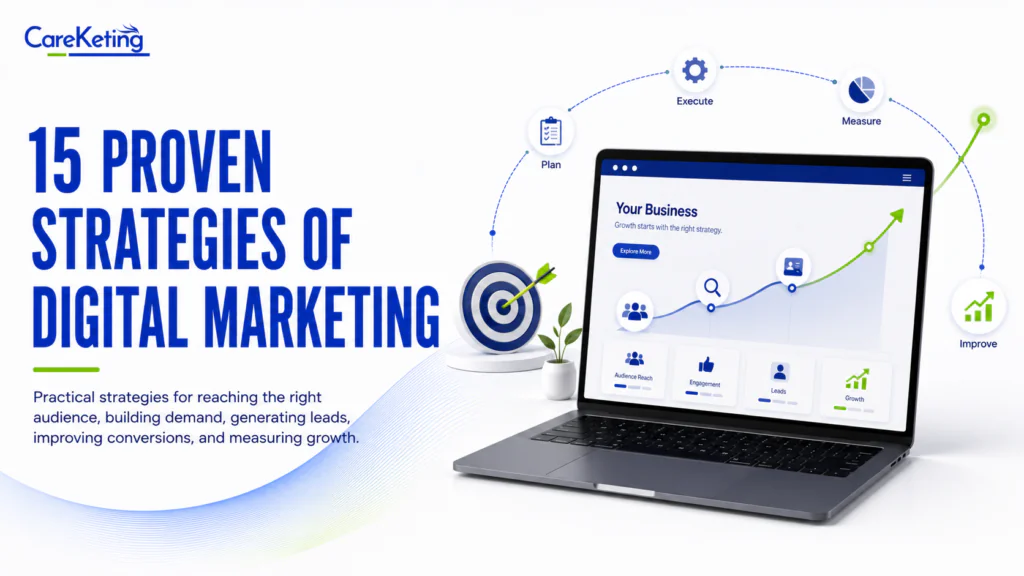
Review performance, identify what worked, find weak points, and make informed changes. This creates a continuous cycle of planning, execution, measurement, and improvement.
How to Build a Digital Marketing Plan
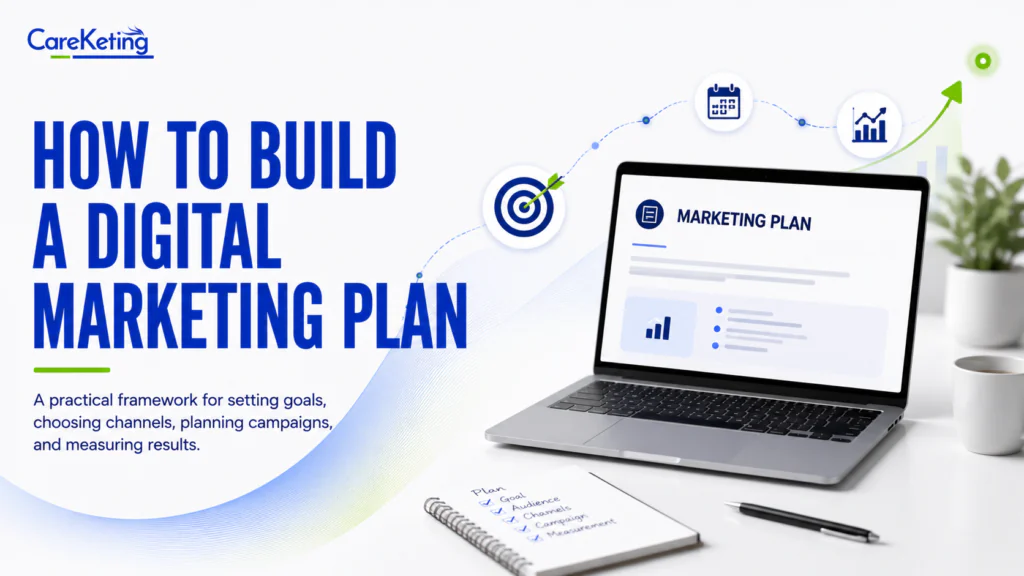
A practical digital marketing planning process can follow this order:
Step 1: Define the business objective.
Step 2: Identify the target audience.
Step 3: Study competitors and customer behaviour.
Step 4: Select suitable digital marketing channels.
Step 5: Create the content and campaign plan.
Step 6: Set the marketing budget.
Step 7: Define KPIs and conversion tracking.
Step 8: Launch, measure, and optimize.
This approach prevents businesses from spending money simply because a particular channel is popular.
Common Mistakes
One common mistake is trying to implement every strategy simultaneously.
Another is creating content without a clear audience or objective.
Businesses also sometimes increase their advertising budget when the real problem is weak messaging, poor targeting, an unclear offer, or slow lead follow up.
Strong digital marketing strategies require coordination between marketing, sales, content, advertising, and customer experience.
Frequently Asked Questions
What are the strategies of digital marketing?
The strategies of digital marketing include audience research, SEO, content marketing, social media, paid advertising, email marketing, lead generation, conversion optimization, remarketing, and performance tracking.
Which digital marketing strategy is best for beginners?
Beginners should start with a clear objective, audience research, useful content, one or two suitable channels, and basic performance tracking rather than trying everything at once.
How do I create a digital marketing strategy?
Define your business goal, research your audience, study competitors, select channels, create a content and campaign plan, set a budget, define KPIs, and continuously review results.
What is a digital marketing framework?
A digital marketing framework is a structured system that connects objectives, audience, channels, messaging, campaigns, measurement, and optimization.
How important is conversion tracking?
Conversion tracking is essential when you want to understand whether marketing activity produces meaningful actions such as enquiries, registrations, purchases, or leads.
How long does a digital marketing strategy take to work?
The timeframe varies by channel and objective. SEO can require sustained effort, while paid campaigns can produce data much faster. Business results also depend on the offer, competition, audience, and sales process.
Conclusion
The strategies of digital marketing are not a checklist that every business must follow in full. They are tools that should be selected according to your audience, business model, customer journey, and marketing objectives.
A small local business may prioritize local SEO and social media. A manufacturer may focus on B2B lead generation, content, search, and targeted advertising. An ecommerce brand may place more emphasis on product advertising, email, remarketing, and conversion optimization.
The strongest digital marketing strategies are built around a simple principle: understand the customer first, choose the right channel second, and measure the business outcome throughout.
Before launching your next campaign, write down your primary marketing goal, ideal customer, chosen channel, expected action, budget, and success metric. That simple plan can make your marketing execution considerably more focused.